
Homepage design: what must be clear in 10 seconds
Visitors form a first impression before reading a word and decide within seconds whether to stay. Here is what must be clear at the top and how to test it in an afternoon.
Seven in ten carts end without an order. Some shoppers just compare prices, while shipping costs, forced accounts, or missing parcel lockers stop others. Here is what to fix.
Every online store faces cart abandonment: according to Baymard Institute, an average of 70.22% of carts end without an order. Some visitors only compare prices, but you can recover carts lost to shipping costs, forced registration, or missing parcel lockers and pick-up points.
Below, we cover the ten most common reasons shoppers don't finish buying in Czechia, a 15-minute mobile checkout test you can run without a developer, and how to rank fixes by impact and effort.
Cart abandonment rate measures the share of filled carts that don't result in a completed order. On its cart abandonment rate page (updated October 2026), the US-based Baymard Institute reports an average of 70.22% across 50 studies from 2006 to 2025.
Seven out of ten carts left in a physical store would be an emergency, but online shoppers also use carts as wish lists or shipping calculators. In Baymard's US survey, 42% of shoppers have abandoned a cart because they were just browsing. Checkout tweaks won't win them over today, though saving the cart after they close the browser makes returning easier.
The remaining causes are fixable. Baymard's US and European tests show that better checkout design can raise a large retailer's e-commerce conversion rate (the share of visits with an order) by 35.26%. Smaller stores will see different numbers, yet every unnecessary checkout hurdle costs orders.
Divide completed orders by the number of carts with items and subtract the result from one: 1,000 carts and 300 monthly orders give a 70% abandonment rate. You will find these numbers in GA4 (add-to-cart and purchase events) or in your store admin if it tracks abandoned carts.
High extra costs—shipping, fees, and taxes—deter shoppers most often. Baymard Institute's US survey excludes people who were just browsing; respondents could pick multiple reasons, so the total exceeds 100%.
These reasons are universal, while Czechia mainly differs in the delivery and payment habits covered below. The table shows how each issue looks in a Czech store and how to fix it.
| Reason (share of responses) | What it looks like in a Czech store | What to do |
|---|---|---|
| Extra costs too high (40%) | Shipping or cash-on-delivery fee revealed at the final step | Show shipping prices on the product page |
| Delivery too slow (20%) | Vague "2–5 business days" with no specific day | Show the estimated delivery day |
| Don't trust site with card info (19%) | Unknown store with no contact details or reviews | Add contacts, a known payment gateway, verified reviews |
| Forced account creation (18%) | Can't order without registering | Offer guest checkout; suggest an account after ordering |
| Long or complicated checkout (17%) | Too many steps and unnecessary fields | Cut fields; autofill company details via IČO |
| Website errors and crashes (17%) | Locker map fails to load, form wipes entered data | Run regular test orders on a phone |
| Unsatisfactory return policy (13%) | Return rules buried in terms and conditions | Link a clear returns page from checkout |
| Can't see total cost up front (12%) | Total with shipping shown right before submitting | Show a running total in the cart |
| Card declined (10%) | Error message with no explanation | Explain the error and offer another payment method |
| Too few payment methods (9%) | Missing Apple Pay, Google Pay, or instant bank transfer | Add the payment methods shoppers expect |
We group the ten reasons into three areas based on where you fix them:
Shoppers go through the entire purchase consideration process, and checkout is simply the final place where you can lose them unnecessarily.
In Baymard's survey, 40% of shoppers cited unexpected costs and 12% couldn't see the total price up front. It feels like an unannounced cover charge on a restaurant bill—except online shoppers leave with a single tap before paying.
Show shipping costs and surcharges early:
Free shipping attracts buyers, but it comes out of your margin. A practical middle ground is setting a free-shipping threshold slightly above your average order value to encourage adding another item.
In the cart, show: "Add … more for free shipping." If you prefer not to offer free shipping, that is fine—a price known from the start matters more than zero cost.
Czech shoppers most often ship orders to self-service parcel lockers and pick-up points. According to APEK data, 48.1% of respondents chose parcel lockers in 2025 (up from 13.3% in 2022), and the number of lockers across Czechia grew to 15,000 in 2025.
Parcel lockers and pick-up points are no longer optional extras. Shoppers pick the network closest to home—if your checkout lacks it, they buy elsewhere.
How they choose matters just as much. Instead of a long address dropdown, embed an address-searchable map that shows nearby lockers and remembers the customer's last choice.
According to the State of Czech E-commerce 2025 report by Shoptet and APEK, Czech shoppers most often pay by:
What this means for your store:
More options don't make a better checkout. Offer only the carriers and payment methods your audience actually uses, and place the top choices first.
Forced registration drives away 18% of shoppers (Baymard Institute survey). Allow guest checkout and offer account creation after the order—the buyer simply adds a password to the details already entered.
Baymard's 2024 study found the average e-commerce checkout has 11.3 form fields, though most stores only need 8. How to shorten and simplify your form:
Fear of entering card details on an unfamiliar site makes 19% of shoppers leave (Baymard Institute). Small checkout details decide: a visible phone number and email, clear company info, a familiar payment gateway, and customer reviews.
Since January 6, 2023 (Act No. 374/2022 Sb.), sellers displaying consumer reviews in Czechia must state how they verify those reviews come from real buyers. The Czech Trade Inspection Authority highlights this in its consumer protection law update.
We explain how to collect credible reviews and respond to negative ones in our guide to Google reviews.
An unsatisfactory return policy deters 13% of shoppers (Baymard Institute). Add a clear page explaining the return window, process, and return shipping costs, linked right from checkout. Moreover, from January 1, 2027, Act No. 159/2026 Sb. mandates a contract withdrawal button—so review your entire return flow now.
Placing a real order on your phone is the cheapest checkout audit—desktop screens hide many mobile obstacles:
Note and screenshot every hesitation—any moment you aren't sure what to do next, have to hunt for info, or feel surprised. Put TEST in the order note and cancel it afterward.
Repeat the test with someone who doesn't know your store, such as a friend or relative. Ask them to think aloud without your help. Wherever they pause, real customers get stuck too.
Step-by-step checkout analytics show where shoppers drop off. In Google Analytics 4, use Funnel exploration. You can map up to 10 steps (such as cart, shipping, payment, and completion) to see how many visitors continue or leave.
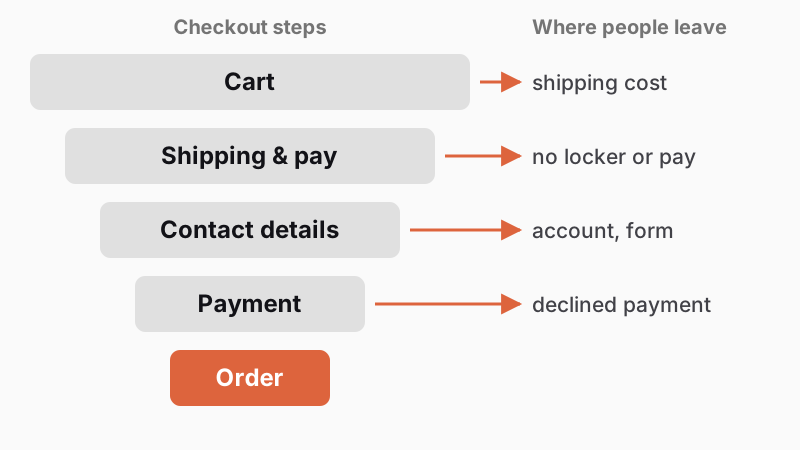
The funnel shows where the problem is, not why. Pair it with your mobile test. If visitors leave at shipping and the locker map loads slowly on your phone, you know what to fix first.
Rank fixes by how many orders they save versus the effort required. This table gives a rough guide for a typical Czech online store; your priorities may vary by platform and product range.
| Fix | Impact | Effort |
|---|---|---|
| Shipping cost on product pages | high | low |
| Guest checkout | high | low to medium |
| Map-based locker picker and delivery day | high | medium |
| Apple Pay, Google Pay, and QR payment | medium | low to medium |
| Shorter form and IČO autofill | medium | medium |
| Full checkout rebuild | high | high |
Start with high-impact, low-effort changes. Track your abandonment rate for at least four weeks outside seasonal peaks and sales. Rebuild the entire checkout only when minor tweaks fall short or your current e-commerce platform blocks them.
You can also remind departing visitors if you follow email marketing rules. If shoppers leave before adding anything to the cart, start where the visit begins. Our website homepage guide covers what visitors need to grasp right away.
If you are planning a new online store or a checkout rebuild integrated with Czech carriers and payment methods, estimate the price in our project configurator and see the details under e-commerce development.
According to Baymard Institute (an average of 50 studies from 2006–2025, updated October 2026), the average is 70.22%. Because studies measure abandonment differently, track your own store's rate over time instead.
It depends on your margins and average order value, since product prices must cover delivery costs. Setting a free-shipping threshold just above your average order value—with a cart indicator showing how much remains—often works well. What matters most is showing shipping costs up front.
Yes, if your customers use it (in Czechia, 13% of shoppers prefer it according to State of Czech E-commerce 2025). To offset handling costs and uncollected parcels, show a fair fee right when the buyer selects a payment method. Let your own store data guide you.
Use step-by-step checkout analytics. Set up a Funnel exploration in Google Analytics 4 from cart view to completed purchase to see exactly where visitors drop off. Then run a test order on your phone to uncover why they leave.
Proceed carefully—under Czech law (Act No. 480/2004 Sb.), these count as commercial communications. You may send them only with prior consent, or to existing customers for similar products with an easy opt-out. Sending reminders only with prior consent is the safest route. Consult a lawyer on your setup; this article does not replace legal advice.
Handpicked topics for you
Visitors form a first impression before reading a word and decide within seconds whether to stay. Here is what must be clear at the top and how to test it in an afternoon.
Most new online stores only need a hosted platform. Learn how to spot when you outgrow it and when custom e-commerce is an unnecessary expense.
Read about the 7 emotions that drive people when buying goods or services, and which brands exemplify them.
Seven in ten carts end without an order. Some shoppers just compare prices, while shipping costs, forced accounts, or missing parcel lockers stop others. Here is what to fix.
Every online store faces cart abandonment: according to Baymard Institute, an average of 70.22% of carts end without an order. Some visitors only compare prices, but you can recover carts lost to shipping costs, forced registration, or missing parcel lockers and pick-up points.
Below, we cover the ten most common reasons shoppers don't finish buying in Czechia, a 15-minute mobile checkout test you can run without a developer, and how to rank fixes by impact and effort.
Cart abandonment rate measures the share of filled carts that don't result in a completed order. On its cart abandonment rate page (updated October 2026), the US-based Baymard Institute reports an average of 70.22% across 50 studies from 2006 to 2025.
Seven out of ten carts left in a physical store would be an emergency, but online shoppers also use carts as wish lists or shipping calculators. In Baymard's US survey, 42% of shoppers have abandoned a cart because they were just browsing. Checkout tweaks won't win them over today, though saving the cart after they close the browser makes returning easier.
The remaining causes are fixable. Baymard's US and European tests show that better checkout design can raise a large retailer's e-commerce conversion rate (the share of visits with an order) by 35.26%. Smaller stores will see different numbers, yet every unnecessary checkout hurdle costs orders.
Divide completed orders by the number of carts with items and subtract the result from one: 1,000 carts and 300 monthly orders give a 70% abandonment rate. You will find these numbers in GA4 (add-to-cart and purchase events) or in your store admin if it tracks abandoned carts.
High extra costs—shipping, fees, and taxes—deter shoppers most often. Baymard Institute's US survey excludes people who were just browsing; respondents could pick multiple reasons, so the total exceeds 100%.
These reasons are universal, while Czechia mainly differs in the delivery and payment habits covered below. The table shows how each issue looks in a Czech store and how to fix it.
| Reason (share of responses) | What it looks like in a Czech store | What to do |
|---|---|---|
| Extra costs too high (40%) | Shipping or cash-on-delivery fee revealed at the final step | Show shipping prices on the product page |
| Delivery too slow (20%) | Vague "2–5 business days" with no specific day | Show the estimated delivery day |
| Don't trust site with card info (19%) | Unknown store with no contact details or reviews | Add contacts, a known payment gateway, verified reviews |
| Forced account creation (18%) | Can't order without registering | Offer guest checkout; suggest an account after ordering |
| Long or complicated checkout (17%) | Too many steps and unnecessary fields | Cut fields; autofill company details via IČO |
| Website errors and crashes (17%) | Locker map fails to load, form wipes entered data | Run regular test orders on a phone |
| Unsatisfactory return policy (13%) | Return rules buried in terms and conditions | Link a clear returns page from checkout |
| Can't see total cost up front (12%) | Total with shipping shown right before submitting | Show a running total in the cart |
| Card declined (10%) | Error message with no explanation | Explain the error and offer another payment method |
| Too few payment methods (9%) | Missing Apple Pay, Google Pay, or instant bank transfer | Add the payment methods shoppers expect |
We group the ten reasons into three areas based on where you fix them:
Shoppers go through the entire purchase consideration process, and checkout is simply the final place where you can lose them unnecessarily.
In Baymard's survey, 40% of shoppers cited unexpected costs and 12% couldn't see the total price up front. It feels like an unannounced cover charge on a restaurant bill—except online shoppers leave with a single tap before paying.
Show shipping costs and surcharges early:
Free shipping attracts buyers, but it comes out of your margin. A practical middle ground is setting a free-shipping threshold slightly above your average order value to encourage adding another item.
In the cart, show: "Add … more for free shipping." If you prefer not to offer free shipping, that is fine—a price known from the start matters more than zero cost.
Czech shoppers most often ship orders to self-service parcel lockers and pick-up points. According to APEK data, 48.1% of respondents chose parcel lockers in 2025 (up from 13.3% in 2022), and the number of lockers across Czechia grew to 15,000 in 2025.
Parcel lockers and pick-up points are no longer optional extras. Shoppers pick the network closest to home—if your checkout lacks it, they buy elsewhere.
How they choose matters just as much. Instead of a long address dropdown, embed an address-searchable map that shows nearby lockers and remembers the customer's last choice.
According to the State of Czech E-commerce 2025 report by Shoptet and APEK, Czech shoppers most often pay by:
What this means for your store:
More options don't make a better checkout. Offer only the carriers and payment methods your audience actually uses, and place the top choices first.
Forced registration drives away 18% of shoppers (Baymard Institute survey). Allow guest checkout and offer account creation after the order—the buyer simply adds a password to the details already entered.
Baymard's 2024 study found the average e-commerce checkout has 11.3 form fields, though most stores only need 8. How to shorten and simplify your form:
Fear of entering card details on an unfamiliar site makes 19% of shoppers leave (Baymard Institute). Small checkout details decide: a visible phone number and email, clear company info, a familiar payment gateway, and customer reviews.
Since January 6, 2023 (Act No. 374/2022 Sb.), sellers displaying consumer reviews in Czechia must state how they verify those reviews come from real buyers. The Czech Trade Inspection Authority highlights this in its consumer protection law update.
We explain how to collect credible reviews and respond to negative ones in our guide to Google reviews.
An unsatisfactory return policy deters 13% of shoppers (Baymard Institute). Add a clear page explaining the return window, process, and return shipping costs, linked right from checkout. Moreover, from January 1, 2027, Act No. 159/2026 Sb. mandates a contract withdrawal button—so review your entire return flow now.
Placing a real order on your phone is the cheapest checkout audit—desktop screens hide many mobile obstacles:
Note and screenshot every hesitation—any moment you aren't sure what to do next, have to hunt for info, or feel surprised. Put TEST in the order note and cancel it afterward.
Repeat the test with someone who doesn't know your store, such as a friend or relative. Ask them to think aloud without your help. Wherever they pause, real customers get stuck too.
Step-by-step checkout analytics show where shoppers drop off. In Google Analytics 4, use Funnel exploration. You can map up to 10 steps (such as cart, shipping, payment, and completion) to see how many visitors continue or leave.
The funnel shows where the problem is, not why. Pair it with your mobile test. If visitors leave at shipping and the locker map loads slowly on your phone, you know what to fix first.
Rank fixes by how many orders they save versus the effort required. This table gives a rough guide for a typical Czech online store; your priorities may vary by platform and product range.
| Fix | Impact | Effort |
|---|---|---|
| Shipping cost on product pages | high | low |
| Guest checkout | high | low to medium |
| Map-based locker picker and delivery day | high | medium |
| Apple Pay, Google Pay, and QR payment | medium | low to medium |
| Shorter form and IČO autofill | medium | medium |
| Full checkout rebuild | high | high |
Start with high-impact, low-effort changes. Track your abandonment rate for at least four weeks outside seasonal peaks and sales. Rebuild the entire checkout only when minor tweaks fall short or your current e-commerce platform blocks them.
You can also remind departing visitors if you follow email marketing rules. If shoppers leave before adding anything to the cart, start where the visit begins. Our website homepage guide covers what visitors need to grasp right away.
If you are planning a new online store or a checkout rebuild integrated with Czech carriers and payment methods, estimate the price in our project configurator and see the details under e-commerce development.
According to Baymard Institute (an average of 50 studies from 2006–2025, updated October 2026), the average is 70.22%. Because studies measure abandonment differently, track your own store's rate over time instead.
It depends on your margins and average order value, since product prices must cover delivery costs. Setting a free-shipping threshold just above your average order value—with a cart indicator showing how much remains—often works well. What matters most is showing shipping costs up front.
Yes, if your customers use it (in Czechia, 13% of shoppers prefer it according to State of Czech E-commerce 2025). To offset handling costs and uncollected parcels, show a fair fee right when the buyer selects a payment method. Let your own store data guide you.
Use step-by-step checkout analytics. Set up a Funnel exploration in Google Analytics 4 from cart view to completed purchase to see exactly where visitors drop off. Then run a test order on your phone to uncover why they leave.
Proceed carefully—under Czech law (Act No. 480/2004 Sb.), these count as commercial communications. You may send them only with prior consent, or to existing customers for similar products with an easy opt-out. Sending reminders only with prior consent is the safest route. Consult a lawyer on your setup; this article does not replace legal advice.
Handpicked topics for you
Visitors form a first impression before reading a word and decide within seconds whether to stay. Here is what must be clear at the top and how to test it in an afternoon.
Most new online stores only need a hosted platform. Learn how to spot when you outgrow it and when custom e-commerce is an unnecessary expense.
Read about the 7 emotions that drive people when buying goods or services, and which brands exemplify them.