How to get Google reviews and respond to negative ones
Many businesses unknowingly break EU law or Google's rules when collecting reviews. Here is how to get honest reviews, reply to criticism, and handle fake ratings.
Email is the cheapest way to reach your customers if you send legally and land in the inbox. We explain the law, technical setup, and why Seznam rules Czech inboxes.

Email marketing rules allow you to message people who gave you consent, and your own customers if you offer similar goods or services and include an easy unsubscribe option in every email. To keep messages out of spam, your domain needs SPF, DKIM, and DMARC records.
Email is the cheapest way to reach customers who already know you, provided you write legally and land in their inbox. For Czech inboxes, both areas are shifting: the Chamber of Deputies passed a new Digital Economy Act, and mailbox providers tightened bulk-sending rules (in Czechia, Seznam sets the pace). Here we combine legal compliance and technical setup into one workflow as of November 13, 2026. This text does not replace legal advice.
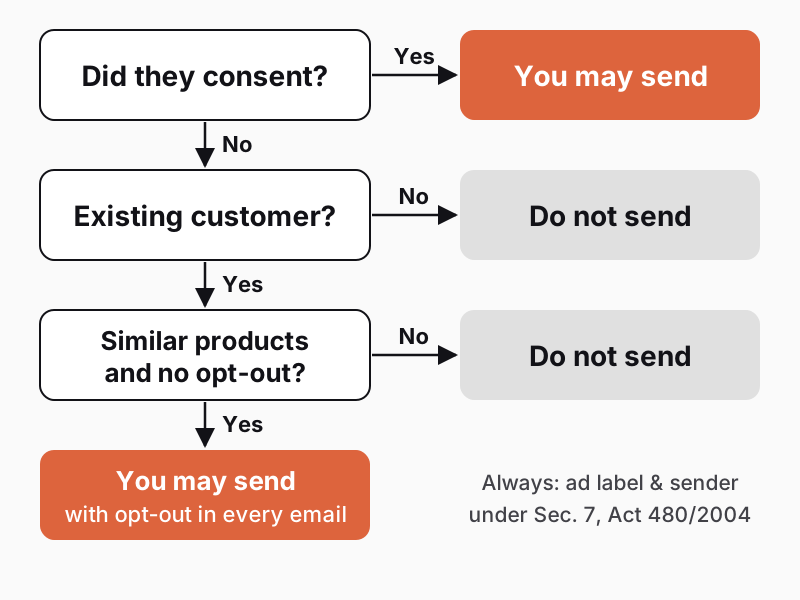
You always need prior consent for commercial emails unless you are writing to an existing customer about your own similar products. In Czechia, this is set by Section 7 of Act No. 480/2004 Coll. Any message that directly or indirectly promotes sales or your company's image counts as a commercial communication, including a tips newsletter.
The customer exemption has four conditions:
The Czech Office for Personal Data Protection (ÚOOÚ) clarifies in its FAQ that a customer is someone who entered into a contract with your company (paid or free), not merely a contest entrant or a prospect.
Example: A fictional online bakery sells cakes. It may offer Christmas cookies (similar goods) without consent to a customer who bought a birthday cake, but not partner insurance. It may email a cake-contest entrant only with consent.
Every email must also meet three formal requirements under Section 7(4):
ÚOOÚ recommends confirming newsletter sign-ups by email (double opt-in). The sender bears the burden of proof and must prove consent if a recipient complains.
Under GDPR, marketing consent must be freely given, specific, informed, and unambiguous. Use a separate, unticked checkbox outside your terms and conditions. State what you send and how often, and link to your privacy notice. Purchased lists and blanket consent for "all partners" will not hold up.
Czechia's new Digital Economy Act limits the customer exemption to two years from the last commercial email. The Chamber of Deputies passed it on November 4, 2026. According to a summary by Sedláková Legal from November 11, 2026, it still awaits the Senate and presidential signature, taking effect fifteen days after publication in the Collection of Laws to replace Act No. 480/2004 Coll.
Core rules and ÚOOÚ oversight stay in place, while fines increase and the two-year cap applies. Under the approved draft, the period will not expire earlier than two years after the Act takes effect, leaving time to prepare.
| Area | Today (Act No. 480/2004 Coll.) | After the new Act takes effect (Deputies' draft) |
|---|---|---|
| Contacts with consent | you may send | no change |
| Own customers without consent | similar products, opt-out in every email | same, up to two years from last commercial email |
| Transition period | – | limit expires no earlier than two years after effective date |
| Maximum corporate fine | CZK 10 million | EUR 20 million or 4% of global turnover |
| Regulator | ÚOOÚ | ÚOOÚ |
The Senate may still amend the wording (the table reflects November 13, 2026). Because the two-year clock runs from the last message, it mainly affects businesses reviving dormant contacts after years of silence.
Before the Act takes effect, we recommend three steps:
Auditing your list prepares you for the new law and improves deliverability. With a spreadsheet from your email tool, you can finish it in an afternoon:
An audit brings commercial gains too. A smaller list of engaged readers means fewer spam complaints and better inbox placement. Repeat purchases from email also cost nothing in extra ad spend; see how we calculate acquisition cost in Customer acquisition cost.
Emails mostly land in spam when the recipient's inbox cannot verify that your company sent them. Domain DNS records—SPF, DKIM, and DMARC—handle this verification. When they are missing or misconfigured, the inbox treats your message as a potential fake.
Think of a physical letter:
| Record | In plain English | What happens without it |
|---|---|---|
| SPF | list of servers allowed to send mail for your domain | the inbox cannot recognize an authorized server |
| DKIM | digital signature of the message | no way to verify the message wasn't altered in transit |
| DMARC | rule for unverified mail and spoofing reports | scammers can more easily send email in your name |
Setups often break when you change your newsletter tool, e-commerce platform, or mail server. If you do not add the new service to SPF and set up DKIM, messages leave from a server your domain does not recognize. Check that your records include every sending service after each change.
Roll out DMARC gradually:
Since February 1, 2024, Gmail requires all senders to use at least SPF or DKIM and keep spam rates below 0.3% (under 0.1% recommended). Sending 5,000 or more messages a day to Gmail requires SPF, DKIM, and DMARC, sender domain alignment with SPF or DKIM, and one-click unsubscribe in marketing emails.
DMARC also stops scammers from sending fake invoices under your company's name. We cover further defenses in Cybersecurity for businesses.
In Czechia, Seznam largely decides inbox placement. In a February 2025 analysis of 5,404,024 client mailboxes from December 2024, agency Etnetera Activate found Seznam held 64.5%, Gmail 24.2%, and Centrum 5.6%.
In its bulk-sender guidelines, Seznam requires valid SPF (covering all sending servers) and DKIM records; without them, emails go to spam or never arrive. It strongly recommends DMARC, noting that it is becoming mandatory worldwide.
Providers also track clicks on "Report spam." Write only to people who want to hear from you, and make the unsubscribe link easy to find—anyone who cannot spot it will mark the email as spam.
People open emails that help them and match their purchases. A steady schedule and interest-based segments work better than discounts for everyone.
Send an automated sequence right after sign-up. Thank the subscriber, confirm how often you write, and share your best content in the first email, then introduce your business and answer common questions.
Follow a purchase with a how-to guide and ask for a review later. A fictional cosmetics shop might send cream-application tips after a week and a review link a week later. Under ÚOOÚ guidance, a review request is also a commercial communication and follows the same rules as a newsletter. Read more in Google reviews and Abandoned cart.
Constant discounts train customers to wait for a sale. Send guides, comparisons, seasonal tips, or new arrivals instead. A fictional joinery could send monthly wood-care tips and a new collection once a quarter.
State how often you will write at sign-up and stick to it. Segment contacts by interest and separate buyers from non-buyers. This keeps spam reports down.
Paid marketing campaigns bring in new customers, and email brings them back. We are happy to help configure your domain or owned channels—contact us.
Only to your own customers, and only about similar products. They must have had a free, simple way to refuse messages both when you collected the address and in every email. Everyone else requires prior consent.
Yes. According to ÚOOÚ, Act No. 480/2004 Coll. applies equally to individuals and companies. You may email a business only with consent, or as your own customer about similar products. Purchased B2B lists cannot be used.
Three records in your domain settings that confirm an email really came from you:
Seznam requires valid SPF and DKIM records and recommends DMARC (including authorization for your email platform). Without them, emails fall into spam or bounce. Also write only to people who want your messages and include a simple unsubscribe link.
Under the version passed by the Chamber of Deputies on November 4, 2026, you may email customers without consent for at most two years from your last commercial email (expiring no earlier than two years after the Act takes effect). Fines also rise, while ÚOOÚ remains the regulator. As of November 13, 2026, the Act awaits the Senate.
Handpicked topics for you
Many businesses unknowingly break EU law or Google's rules when collecting reviews. Here is how to get honest reviews, reply to criticism, and handle fake ratings.
Before setting your ad budget, find out what you can pay per customer. Without it, you won't know if ads make a profit. Calculate it from your margin in ten minutes.
Attackers need very little to breach smaller firms. Here are 10 low-cost steps and how the new Czech NIS2 law affects you, even if you are not regulated.
Email is the cheapest way to reach your customers if you send legally and land in the inbox. We explain the law, technical setup, and why Seznam rules Czech inboxes.
Email marketing rules allow you to message people who gave you consent, and your own customers if you offer similar goods or services and include an easy unsubscribe option in every email. To keep messages out of spam, your domain needs SPF, DKIM, and DMARC records.
Email is the cheapest way to reach customers who already know you, provided you write legally and land in their inbox. For Czech inboxes, both areas are shifting: the Chamber of Deputies passed a new Digital Economy Act, and mailbox providers tightened bulk-sending rules (in Czechia, Seznam sets the pace). Here we combine legal compliance and technical setup into one workflow as of November 13, 2026. This text does not replace legal advice.
You always need prior consent for commercial emails unless you are writing to an existing customer about your own similar products. In Czechia, this is set by Section 7 of Act No. 480/2004 Coll. Any message that directly or indirectly promotes sales or your company's image counts as a commercial communication, including a tips newsletter.
The customer exemption has four conditions:
The Czech Office for Personal Data Protection (ÚOOÚ) clarifies in its FAQ that a customer is someone who entered into a contract with your company (paid or free), not merely a contest entrant or a prospect.
Example: A fictional online bakery sells cakes. It may offer Christmas cookies (similar goods) without consent to a customer who bought a birthday cake, but not partner insurance. It may email a cake-contest entrant only with consent.
Every email must also meet three formal requirements under Section 7(4):
ÚOOÚ recommends confirming newsletter sign-ups by email (double opt-in). The sender bears the burden of proof and must prove consent if a recipient complains.
Under GDPR, marketing consent must be freely given, specific, informed, and unambiguous. Use a separate, unticked checkbox outside your terms and conditions. State what you send and how often, and link to your privacy notice. Purchased lists and blanket consent for "all partners" will not hold up.
Czechia's new Digital Economy Act limits the customer exemption to two years from the last commercial email. The Chamber of Deputies passed it on November 4, 2026. According to a summary by Sedláková Legal from November 11, 2026, it still awaits the Senate and presidential signature, taking effect fifteen days after publication in the Collection of Laws to replace Act No. 480/2004 Coll.
Core rules and ÚOOÚ oversight stay in place, while fines increase and the two-year cap applies. Under the approved draft, the period will not expire earlier than two years after the Act takes effect, leaving time to prepare.
| Area | Today (Act No. 480/2004 Coll.) | After the new Act takes effect (Deputies' draft) |
|---|---|---|
| Contacts with consent | you may send | no change |
| Own customers without consent | similar products, opt-out in every email | same, up to two years from last commercial email |
| Transition period | – | limit expires no earlier than two years after effective date |
| Maximum corporate fine | CZK 10 million | EUR 20 million or 4% of global turnover |
| Regulator | ÚOOÚ | ÚOOÚ |
The Senate may still amend the wording (the table reflects November 13, 2026). Because the two-year clock runs from the last message, it mainly affects businesses reviving dormant contacts after years of silence.
Before the Act takes effect, we recommend three steps:
Auditing your list prepares you for the new law and improves deliverability. With a spreadsheet from your email tool, you can finish it in an afternoon:
An audit brings commercial gains too. A smaller list of engaged readers means fewer spam complaints and better inbox placement. Repeat purchases from email also cost nothing in extra ad spend; see how we calculate acquisition cost in Customer acquisition cost.
Emails mostly land in spam when the recipient's inbox cannot verify that your company sent them. Domain DNS records—SPF, DKIM, and DMARC—handle this verification. When they are missing or misconfigured, the inbox treats your message as a potential fake.
Think of a physical letter:
| Record | In plain English | What happens without it |
|---|---|---|
| SPF | list of servers allowed to send mail for your domain | the inbox cannot recognize an authorized server |
| DKIM | digital signature of the message | no way to verify the message wasn't altered in transit |
| DMARC | rule for unverified mail and spoofing reports | scammers can more easily send email in your name |
Setups often break when you change your newsletter tool, e-commerce platform, or mail server. If you do not add the new service to SPF and set up DKIM, messages leave from a server your domain does not recognize. Check that your records include every sending service after each change.
Roll out DMARC gradually:
Since February 1, 2024, Gmail requires all senders to use at least SPF or DKIM and keep spam rates below 0.3% (under 0.1% recommended). Sending 5,000 or more messages a day to Gmail requires SPF, DKIM, and DMARC, sender domain alignment with SPF or DKIM, and one-click unsubscribe in marketing emails.
DMARC also stops scammers from sending fake invoices under your company's name. We cover further defenses in Cybersecurity for businesses.
In Czechia, Seznam largely decides inbox placement. In a February 2025 analysis of 5,404,024 client mailboxes from December 2024, agency Etnetera Activate found Seznam held 64.5%, Gmail 24.2%, and Centrum 5.6%.
In its bulk-sender guidelines, Seznam requires valid SPF (covering all sending servers) and DKIM records; without them, emails go to spam or never arrive. It strongly recommends DMARC, noting that it is becoming mandatory worldwide.
Providers also track clicks on "Report spam." Write only to people who want to hear from you, and make the unsubscribe link easy to find—anyone who cannot spot it will mark the email as spam.
People open emails that help them and match their purchases. A steady schedule and interest-based segments work better than discounts for everyone.
Send an automated sequence right after sign-up. Thank the subscriber, confirm how often you write, and share your best content in the first email, then introduce your business and answer common questions.
Follow a purchase with a how-to guide and ask for a review later. A fictional cosmetics shop might send cream-application tips after a week and a review link a week later. Under ÚOOÚ guidance, a review request is also a commercial communication and follows the same rules as a newsletter. Read more in Google reviews and Abandoned cart.
Constant discounts train customers to wait for a sale. Send guides, comparisons, seasonal tips, or new arrivals instead. A fictional joinery could send monthly wood-care tips and a new collection once a quarter.
State how often you will write at sign-up and stick to it. Segment contacts by interest and separate buyers from non-buyers. This keeps spam reports down.
Paid marketing campaigns bring in new customers, and email brings them back. We are happy to help configure your domain or owned channels—contact us.
Only to your own customers, and only about similar products. They must have had a free, simple way to refuse messages both when you collected the address and in every email. Everyone else requires prior consent.
Yes. According to ÚOOÚ, Act No. 480/2004 Coll. applies equally to individuals and companies. You may email a business only with consent, or as your own customer about similar products. Purchased B2B lists cannot be used.
Three records in your domain settings that confirm an email really came from you:
Seznam requires valid SPF and DKIM records and recommends DMARC (including authorization for your email platform). Without them, emails fall into spam or bounce. Also write only to people who want your messages and include a simple unsubscribe link.
Under the version passed by the Chamber of Deputies on November 4, 2026, you may email customers without consent for at most two years from your last commercial email (expiring no earlier than two years after the Act takes effect). Fines also rise, while ÚOOÚ remains the regulator. As of November 13, 2026, the Act awaits the Senate.
Handpicked topics for you
Many businesses unknowingly break EU law or Google's rules when collecting reviews. Here is how to get honest reviews, reply to criticism, and handle fake ratings.
Before setting your ad budget, find out what you can pay per customer. Without it, you won't know if ads make a profit. Calculate it from your margin in ten minutes.
Attackers need very little to breach smaller firms. Here are 10 low-cost steps and how the new Czech NIS2 law affects you, even if you are not regulated.