Marketing budget: how to split brand and performance
Base your total spend on customer economics. For splitting brand and performance, IPA's 60:40 average is a useful guide. Track brand strength free in twenty minutes a month.
Many businesses unknowingly break EU law or Google's rules when collecting reviews. Here is how to get honest reviews, reply to criticism, and handle fake ratings.

The most reliable way to learn how to get Google reviews is to ask every customer the same way after a purchase or completed job: one direct link, no reward, and no filtering for happy buyers only. Reply to criticism quickly and factually—everyone considering buying from you reads your response.
Reviews decide whom a customer picks and where your business ranks on maps. Yet many companies unknowingly break the law or Google's rules: they offer discounts for ratings, ask only satisfied buyers, or fail to state on their website how they verify reviews. Below we cover EU and Czech law, Google's policies, the Czech platforms Heureka and Firmy.cz, a system for collecting reviews, and a template for replying to negative feedback. Information reflects rules as of November 13, 2026, and is not legal advice.
Reviews act as social proof: buyers trust peers more than a company's own claims. A 2020 Google study with 310,000 simulated purchases confirmed this. Even an invented cereal brand pulled 28% of preference away from a category favorite when given five-star reviews and 20% extra free.
Picture two pubs on a square—most people walk into the busy one, expecting good food. We explore this further in our article on how emotions shape purchase decisions.
Reviews also affect local search rankings. Rankings depend on relevance, distance, and prominence, where Google states that more reviews and positive ratings can improve local ranking. Stars alone will not secure top spot, though, if your business is far away or does not match the search.
AI reads ratings too. Google rolled out Gemini review summaries in Maps in the US in October 2024, and according to Seznam as of October 2026, its Seznam AI assistant pulls data from Firmy.cz among other sources. What customers write about you feeds straight into AI answers. See our guide to AI search for how to appear there.
Ads bring people to your profile, while reviews often decide whether they call. Reviews keep working after you pause ad spend and remain one of the cheapest ways to build trust. We cover splitting spend between brand and performance in Marketing budget.
Under the EU Omnibus Directive—implemented in Czechia since January 6, 2023, via Section 5a(5) of Consumer Protection Act No. 634/1992 Coll. (amendment No. 374/2022 Coll.)—anyone displaying reviews on their website must state whether and how they verify that those reviews come from real customers. Leaving this out counts as a misleading omission. The law does not force you to verify reviews; you just have to state truthfully whether and how you do.
Annex 1 of the same Act always bans:
Buying reviews is illegal, and in Czechia the Czech Trade Inspection Authority (Česká obchodní inspekce) enforces these rules. Still, you break the law even if you collect reviews honestly and simply forget to explain on your site how they were gathered.
Adapt these sample disclosures to match your actual process:
Even "we do not verify" satisfies the law, as long as you do not present unverified reviews as verified. When embedding reviews from Google or a program like Heureka Ověřeno zákazníky, name the source so readers know who verified them.
Google lets you ask for reviews, yet bans buying, rewarding, filtering, or writing them in-house. Under Google Maps user-contributed content policy (as of November 2026), Google reviews must reflect genuine experience. Google bans:
You may encourage customers to share their experience if you promise nothing in return and do not steer the star rating or wording. Google provides a direct link and QR code for this.
Google removes violating reviews and may restrict or suspend your Business Profile for breaking rules.
A common mistake is sending a survey that shows the Google link only to top-scoring customers. Google bans this kind of filtering—you must offer the review link to everyone.
| Practice | Allowed? | Basis |
|---|---|---|
| Asking all customers for a review | Yes | Google policy |
| Discount or gift for a review | No | Google policy |
| Review link for happy buyers only | No | Google policy |
| Reviews from staff and relatives | No | Google policy (conflict of interest) |
| Staff quotas for collecting reviews | No | Google policy |
| Website reviews without verification info | No | Section 5a(5) Czech Consumer Protection Act (EU Omnibus) |
| Bought or fabricated reviews | No | Annex 1 of the Act & Google policy |
| Replying factually to criticism | Yes | Google best practices |
| Reporting a policy-violating review | Yes | Google & Firmy.cz policies |
If you sell in Czechia, two local platforms matter alongside Google: Heureka (the leading price-comparison site for e-shops) and Firmy.cz (a business directory tied to Mapy.com and the Seznam search engine) for services and storefronts.
Heureka's Ověřeno zákazníky ("Verified by Customers") program emails post-purchase surveys to real buyers and awards a trust badge to reliable e-shops.
Heureka Group announced on August 4, 2025 a new pricing model in Czechia and Slovakia starting September 2025:
A small e-shop can easily check whether 15 free monthly ratings cover its volume or whether the Profi plan or active ads make more sense.
On Firmy.cz, a signed-in user can rate each business once based on personal experience. Businesses reply in the dashboard and cannot delete a review that follows the rules.
Under Firmy.cz review rules, your reply cannot contain profanity, links, or a phone number—only an email address is allowed. If you reply to an unclear review within 90 days, you can ask to hide it pending clarification. If the author does not respond within 30 days, Firmy.cz deletes it.
According to Seznam in October 2026, Seznam AI draws on Firmy.cz and Zboží.cz. A complete profile helps you show up in AI search too.
For local services (such as auto shops or accountants), Google and Firmy.cz are enough. Heureka pays off mainly for e-shops.
How do you collect reviews without begging? An automated request with a direct link sent to every customer right after delivery or service works best.
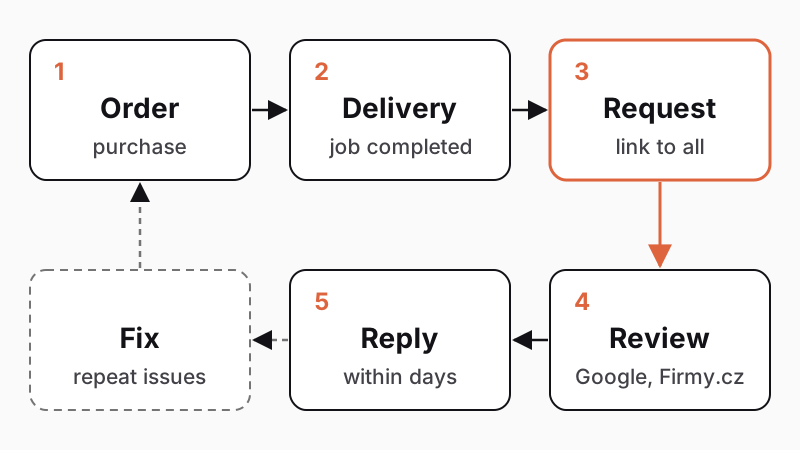
In an e-shop, trigger the request automatically once the carrier confirms delivery. Similar flows power the emails we cover in Abandoned cart. Before sending, check your legal basis for outreach in Email marketing rules.
Bring your team in: staff can mention the link, as long as they have no quotas and never tell buyers what to write.
A good reply to a negative review is prompt, brief, and factual. You write it mainly for future buyers reading it alongside the rating. One calm reply to criticism builds more trust than ten unanswered five-star reviews.
Five steps to a solid reply:
Google advises writing concisely, skipping generic copy-paste lines, and leaving promos out of replies. Google checks your reply before publishing—usually within ten minutes, occasionally up to 30 days. The reviewer gets notified and can update their rating.
Never make a fix conditional on editing or deleting the review. Google bans offering any benefit to change a rating. Fix the mistake because it is the right thing to do.
Do not argue with fake or abusive reviews—report them. Flag the review in your Google Business Profile and pick a reason, or use the Reviews Management Tool to track status. Per Google's guide to reporting reviews, review takes several days. You can appeal a rejected request once.
Google removes only policy violations; it will not arbitrate factual disputes between you and a buyer. On Firmy.cz, click the three dots and select Report a problem. If a false review harms your reputation, consult a lawyer.
Managing reviews does not take all day. Reply as ratings come in, and spend fifteen minutes once a month checking trends. Steady, fresh reviews show your business is active.
Repeated criticism is the cheapest market research you can get, showing early where you lose buyers. If three people a month complain nobody picked up the phone, you do not need better ad copy—you need someone answering calls.
Pair review management with performance marketing campaigns. If you want to connect review requests to your e-shop or order system, tell us how you collect reviews today and we will map out a simple setup.
No. Google's policies ban offering money, discounts, or free goods or services for posting, editing, or deleting a review, and Google removes such ratings. You can ask all customers for honest feedback without rewards or pressure.
Reply within a few days, briefly and factually. Thank the customer, own the mistake, explain without blaming or sharing personal data, offer a fix, and take the chat private. Never tie a fix to editing or deleting the review.
Flag it in your Google Business Profile or the Reviews Management Tool, where you can track status. Review takes several days, and you can appeal a rejection once. Google will not remove fair criticism that follows its rules.
Yes, in the EU. Under the Omnibus Directive (in Czechia, Section 5a(5) of Consumer Protection Act No. 634/1992 Coll., effective January 6, 2023), any trader showing reviews must state whether and how it checks they come from real buyers. Verification is optional, claiming unverified reviews are verified is illegal.
Handpicked topics for you
Base your total spend on customer economics. For splitting brand and performance, IPA's 60:40 average is a useful guide. Track brand strength free in twenty minutes a month.
AI Overviews, AI Mode, ChatGPT, and Seznam AI answer directly in search. See how they pick sources, what not to pay for, and what to fix in 30 days.
Read about the 7 emotions that drive people when buying goods or services, and which brands exemplify them.
Many businesses unknowingly break EU law or Google's rules when collecting reviews. Here is how to get honest reviews, reply to criticism, and handle fake ratings.
The most reliable way to learn how to get Google reviews is to ask every customer the same way after a purchase or completed job: one direct link, no reward, and no filtering for happy buyers only. Reply to criticism quickly and factually—everyone considering buying from you reads your response.
Reviews decide whom a customer picks and where your business ranks on maps. Yet many companies unknowingly break the law or Google's rules: they offer discounts for ratings, ask only satisfied buyers, or fail to state on their website how they verify reviews. Below we cover EU and Czech law, Google's policies, the Czech platforms Heureka and Firmy.cz, a system for collecting reviews, and a template for replying to negative feedback. Information reflects rules as of November 13, 2026, and is not legal advice.
Reviews act as social proof: buyers trust peers more than a company's own claims. A 2020 Google study with 310,000 simulated purchases confirmed this. Even an invented cereal brand pulled 28% of preference away from a category favorite when given five-star reviews and 20% extra free.
Picture two pubs on a square—most people walk into the busy one, expecting good food. We explore this further in our article on how emotions shape purchase decisions.
Reviews also affect local search rankings. Rankings depend on relevance, distance, and prominence, where Google states that more reviews and positive ratings can improve local ranking. Stars alone will not secure top spot, though, if your business is far away or does not match the search.
AI reads ratings too. Google rolled out Gemini review summaries in Maps in the US in October 2024, and according to Seznam as of October 2026, its Seznam AI assistant pulls data from Firmy.cz among other sources. What customers write about you feeds straight into AI answers. See our guide to AI search for how to appear there.
Ads bring people to your profile, while reviews often decide whether they call. Reviews keep working after you pause ad spend and remain one of the cheapest ways to build trust. We cover splitting spend between brand and performance in Marketing budget.
Under the EU Omnibus Directive—implemented in Czechia since January 6, 2023, via Section 5a(5) of Consumer Protection Act No. 634/1992 Coll. (amendment No. 374/2022 Coll.)—anyone displaying reviews on their website must state whether and how they verify that those reviews come from real customers. Leaving this out counts as a misleading omission. The law does not force you to verify reviews; you just have to state truthfully whether and how you do.
Annex 1 of the same Act always bans:
Buying reviews is illegal, and in Czechia the Czech Trade Inspection Authority (Česká obchodní inspekce) enforces these rules. Still, you break the law even if you collect reviews honestly and simply forget to explain on your site how they were gathered.
Adapt these sample disclosures to match your actual process:
Even "we do not verify" satisfies the law, as long as you do not present unverified reviews as verified. When embedding reviews from Google or a program like Heureka Ověřeno zákazníky, name the source so readers know who verified them.
Google lets you ask for reviews, yet bans buying, rewarding, filtering, or writing them in-house. Under Google Maps user-contributed content policy (as of November 2026), Google reviews must reflect genuine experience. Google bans:
You may encourage customers to share their experience if you promise nothing in return and do not steer the star rating or wording. Google provides a direct link and QR code for this.
Google removes violating reviews and may restrict or suspend your Business Profile for breaking rules.
A common mistake is sending a survey that shows the Google link only to top-scoring customers. Google bans this kind of filtering—you must offer the review link to everyone.
| Practice | Allowed? | Basis |
|---|---|---|
| Asking all customers for a review | Yes | Google policy |
| Discount or gift for a review | No | Google policy |
| Review link for happy buyers only | No | Google policy |
| Reviews from staff and relatives | No | Google policy (conflict of interest) |
| Staff quotas for collecting reviews | No | Google policy |
| Website reviews without verification info | No | Section 5a(5) Czech Consumer Protection Act (EU Omnibus) |
| Bought or fabricated reviews | No | Annex 1 of the Act & Google policy |
| Replying factually to criticism | Yes | Google best practices |
| Reporting a policy-violating review | Yes | Google & Firmy.cz policies |
If you sell in Czechia, two local platforms matter alongside Google: Heureka (the leading price-comparison site for e-shops) and Firmy.cz (a business directory tied to Mapy.com and the Seznam search engine) for services and storefronts.
Heureka's Ověřeno zákazníky ("Verified by Customers") program emails post-purchase surveys to real buyers and awards a trust badge to reliable e-shops.
Heureka Group announced on August 4, 2025 a new pricing model in Czechia and Slovakia starting September 2025:
A small e-shop can easily check whether 15 free monthly ratings cover its volume or whether the Profi plan or active ads make more sense.
On Firmy.cz, a signed-in user can rate each business once based on personal experience. Businesses reply in the dashboard and cannot delete a review that follows the rules.
Under Firmy.cz review rules, your reply cannot contain profanity, links, or a phone number—only an email address is allowed. If you reply to an unclear review within 90 days, you can ask to hide it pending clarification. If the author does not respond within 30 days, Firmy.cz deletes it.
According to Seznam in October 2026, Seznam AI draws on Firmy.cz and Zboží.cz. A complete profile helps you show up in AI search too.
For local services (such as auto shops or accountants), Google and Firmy.cz are enough. Heureka pays off mainly for e-shops.
How do you collect reviews without begging? An automated request with a direct link sent to every customer right after delivery or service works best.
In an e-shop, trigger the request automatically once the carrier confirms delivery. Similar flows power the emails we cover in Abandoned cart. Before sending, check your legal basis for outreach in Email marketing rules.
Bring your team in: staff can mention the link, as long as they have no quotas and never tell buyers what to write.
A good reply to a negative review is prompt, brief, and factual. You write it mainly for future buyers reading it alongside the rating. One calm reply to criticism builds more trust than ten unanswered five-star reviews.
Five steps to a solid reply:
Google advises writing concisely, skipping generic copy-paste lines, and leaving promos out of replies. Google checks your reply before publishing—usually within ten minutes, occasionally up to 30 days. The reviewer gets notified and can update their rating.
Never make a fix conditional on editing or deleting the review. Google bans offering any benefit to change a rating. Fix the mistake because it is the right thing to do.
Do not argue with fake or abusive reviews—report them. Flag the review in your Google Business Profile and pick a reason, or use the Reviews Management Tool to track status. Per Google's guide to reporting reviews, review takes several days. You can appeal a rejected request once.
Google removes only policy violations; it will not arbitrate factual disputes between you and a buyer. On Firmy.cz, click the three dots and select Report a problem. If a false review harms your reputation, consult a lawyer.
Managing reviews does not take all day. Reply as ratings come in, and spend fifteen minutes once a month checking trends. Steady, fresh reviews show your business is active.
Repeated criticism is the cheapest market research you can get, showing early where you lose buyers. If three people a month complain nobody picked up the phone, you do not need better ad copy—you need someone answering calls.
Pair review management with performance marketing campaigns. If you want to connect review requests to your e-shop or order system, tell us how you collect reviews today and we will map out a simple setup.
No. Google's policies ban offering money, discounts, or free goods or services for posting, editing, or deleting a review, and Google removes such ratings. You can ask all customers for honest feedback without rewards or pressure.
Reply within a few days, briefly and factually. Thank the customer, own the mistake, explain without blaming or sharing personal data, offer a fix, and take the chat private. Never tie a fix to editing or deleting the review.
Flag it in your Google Business Profile or the Reviews Management Tool, where you can track status. Review takes several days, and you can appeal a rejection once. Google will not remove fair criticism that follows its rules.
Yes, in the EU. Under the Omnibus Directive (in Czechia, Section 5a(5) of Consumer Protection Act No. 634/1992 Coll., effective January 6, 2023), any trader showing reviews must state whether and how it checks they come from real buyers. Verification is optional, claiming unverified reviews are verified is illegal.
Handpicked topics for you
Base your total spend on customer economics. For splitting brand and performance, IPA's 60:40 average is a useful guide. Track brand strength free in twenty minutes a month.
AI Overviews, AI Mode, ChatGPT, and Seznam AI answer directly in search. See how they pick sources, what not to pay for, and what to fix in 30 days.
Read about the 7 emotions that drive people when buying goods or services, and which brands exemplify them.