
Key tasks when building a brand
Why customer brand perception matters for your business and tips on how to improve it.
Base your total spend on customer economics. For splitting brand and performance, IPA's 60:40 average is a useful guide. Track brand strength free in twenty minutes a month.

You cannot base your marketing budget on one universal percentage of revenue, but you can split it sensibly between brand and performance marketing. Research by Les Binet and Peter Field for the UK's Institute of Practitioners in Advertising (IPA) shows an average 60/40 rule pays off—a 60:40 split toward brand. Still, that is an average a small business must adapt to its own situation.
Here we explain why performance marketing alone gets pricier, what the 95/5 rule says, how to set a budget by business stage, and how to build a brand on a budget. We also show share of search, which measures brand strength free in 20 minutes a month.
Performance ads (in search, price comparison sites, or shopping campaigns) reach people already buying. They bring fast, measurable orders, so small businesses often put their whole budget there.
Yet only a limited number of people are searching for your service right now. When more companies bid for them in an auction, cost per click and per customer rises. Think of a pond with more and more anglers: there are no extra fish, they are just harder to catch.
An unknown brand also pays more. People prefer buying from a company they have heard of, while an unfamiliar name needs more clicks per order. Performance ads only harvest demand created by referrals, past experience, or a known brand.
Watch the numbers in your reports too. Ad platforms also claim credit for orders from people who searched your company name directly and would have bought anyway. We explain why reports overstate results in our article on ad conversion attribution. When performance ads stop growing, it helps more if people know you before they start searching.
Three signs warn you are hitting the performance ad ceiling:
Professor John Dawes of the Ehrenberg-Bass Institute formulated the 95/5 rule in 2021 for LinkedIn. On his website, he writes that up to 95% of people or businesses are not currently in the market. Companies switch key suppliers every five years on average: about 20% are in the market in a year and roughly 5% in a quarter. The remaining 95% will buy months or years later. Dawes himself stresses this is a simplification, not an exact law.
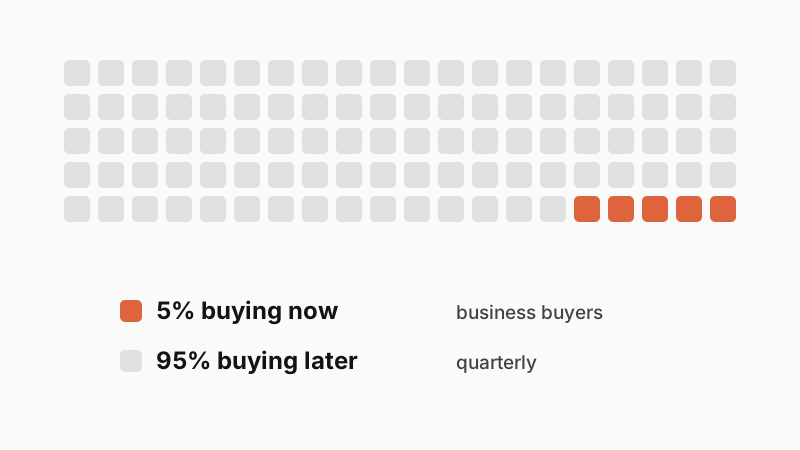
Ads aimed at immediate purchase reach only that 5%. The other 95% need to remember you beforehand: a company may contact a well-known local accounting firm directly, before even searching for a new accountant.
According to Dawes, advertising builds memory links to your brand that fire when a buyer enters the market. Stay visible regularly and spread your budget across the whole year. We cover this in detail in our article on how emotions and the subconscious mind drive decisions.
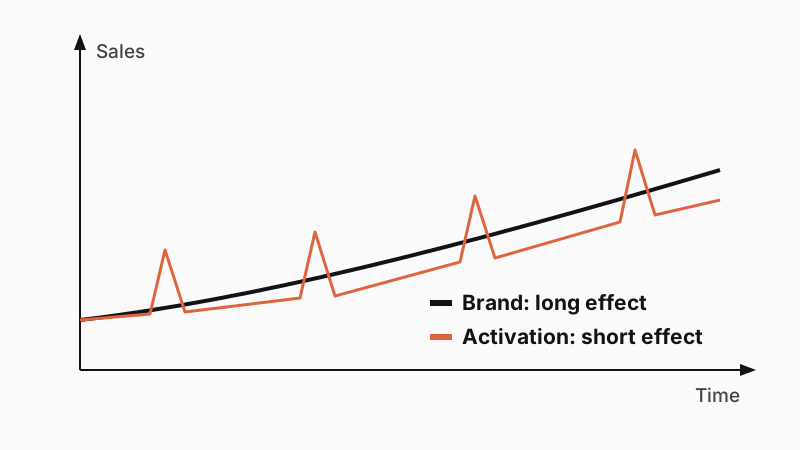
Under Binet and Field's 60/40 rule (IPA), putting 60% of your budget into brand and 40% into immediate sales activation pays off on average. Activation brings a quick sales spike that fades after the campaign. Brand building works slower through memory and emotion, lifting baseline sales and making future activation cheaper. Both approaches complement each other:
The line is blurry: video can sell right away, and search reminds people of your name. When planning, though, clarify whether you expect orders this week or recall next year.
In an October 2023 interview with MediaGuru, Binet himself noted that the 60:40 ratio is not dogma and varies by category, price tier, and brand maturity.
"The 60:40 rule is not a strictly exact iron rule that applies to all brands." — Les Binet, MediaGuru, 2023
For a small business, this sets a direction: putting everything into performance misses the value of a known brand. You need not shift 60% of your budget overnight. Start with a smaller, regular brand spend and watch branded searches and customer cost.
No universal percentage of revenue exists. Base your marketing budget on your goal and customer economics:
Example: an accounting firm wants twenty new clients a year. A client stays four years and brings CZK 15,000 a year after costs, or CZK 60,000 total. Paying at most CZK 10,000 per client caps acquisition spend at CZK 200,000 a year, plus a smaller sum for local brand awareness.
Your business stage shifts the split too: a new firm needs customers, an established one leans more on brand. Rough guide:
| Business stage | Where to spend | What to watch |
|---|---|---|
| New business or market | performance ads, website, reviews, consistent look | cost per customer, review count |
| Growing business | reach: video, PR, sponsorship | branded search, share of search |
| Established brand | brand, harvesting demand via performance ads | market share, margin, discount pressure |
Brand matters more for services bought every few years than for frequent price-driven purchases. Work from your own numbers. If you have none yet, set a first-quarter test budget you can afford to lose and track cost per lead and per order. In three months, you will have your own data.
Share of search is your brand's share of total brand searches in your category. Les Binet presented the metric for the IPA in October 2020: across three studied categories (cars, energy, and mobile phones), it tracked market share and led it—by up to a year for cars. It is fast, cheap, and needs no pricey survey.
A twenty-minute monthly routine:
A rising share signals future market share growth; a drop warns that competitors are catching up. In seasonal industries, compare the same months year over year.
For a small business, regularity, distinctiveness, and trust work best. Staying visible all year on a small spend beats one big spring campaign. Do not change colors, fonts, photo style, or taglines on a whim—the longer you keep them, the easier people remember you.
Other low-cost tactics:
For first steps, see key brand-building tasks, and for how buyers choose, read the purchase consideration process.
Your brand is working when people search you by name and you sell more easily without discounts. Within several months, you should see these signs:
If you do not see these signs after six months, the culprit is usually low reach, inconsistent visuals, or an unclear message. We can help you split your marketing budget between brand and performance and set up tracking in our marketing campaigns from CZK 40,000 per month. For a no-obligation consultation, contact us.
No universal percentage exists; benchmarks mostly reflect large corporations. Base your marketing budget on your goal: how many customers you need and what you can pay per customer while staying profitable. Add a regular brand budget and adjust every quarter.
The 60/40 rule from research by Les Binet and Peter Field for the UK's IPA says that, on average, putting 60% of your budget into brand and 40% into immediate sales pays off. Still, the ratio varies by industry, price point, and brand maturity.
Share of search is your brand's share of searches compared with all brands in your category. Les Binet showed in 2020 that it correlates with market share and can lead it. You can track it free once a month in Google Trends, Keyword Planner, and Search Console (plus Sklik).
Yes. Most future customers are not buying right now and will later pick a business they remember. Consistent visuals, active review care, helpful content, and a modest reach budget (video, local sponsorship) are enough. Brand and performance marketing complement each other—a known name makes performance ads cheaper too.
Handpicked topics for you
Why customer brand perception matters for your business and tips on how to improve it.
Most of our decisions happen subconsciously. How can you use this in sales and marketing?
Before buying, customers search for prices, drawbacks, and comparisons. Here is how to answer them honestly on your website and pick topics that bring real inquiries.
Base your total spend on customer economics. For splitting brand and performance, IPA's 60:40 average is a useful guide. Track brand strength free in twenty minutes a month.
You cannot base your marketing budget on one universal percentage of revenue, but you can split it sensibly between brand and performance marketing. Research by Les Binet and Peter Field for the UK's Institute of Practitioners in Advertising (IPA) shows an average 60/40 rule pays off—a 60:40 split toward brand. Still, that is an average a small business must adapt to its own situation.
Here we explain why performance marketing alone gets pricier, what the 95/5 rule says, how to set a budget by business stage, and how to build a brand on a budget. We also show share of search, which measures brand strength free in 20 minutes a month.
Performance ads (in search, price comparison sites, or shopping campaigns) reach people already buying. They bring fast, measurable orders, so small businesses often put their whole budget there.
Yet only a limited number of people are searching for your service right now. When more companies bid for them in an auction, cost per click and per customer rises. Think of a pond with more and more anglers: there are no extra fish, they are just harder to catch.
An unknown brand also pays more. People prefer buying from a company they have heard of, while an unfamiliar name needs more clicks per order. Performance ads only harvest demand created by referrals, past experience, or a known brand.
Watch the numbers in your reports too. Ad platforms also claim credit for orders from people who searched your company name directly and would have bought anyway. We explain why reports overstate results in our article on ad conversion attribution. When performance ads stop growing, it helps more if people know you before they start searching.
Three signs warn you are hitting the performance ad ceiling:
Professor John Dawes of the Ehrenberg-Bass Institute formulated the 95/5 rule in 2021 for LinkedIn. On his website, he writes that up to 95% of people or businesses are not currently in the market. Companies switch key suppliers every five years on average: about 20% are in the market in a year and roughly 5% in a quarter. The remaining 95% will buy months or years later. Dawes himself stresses this is a simplification, not an exact law.
Ads aimed at immediate purchase reach only that 5%. The other 95% need to remember you beforehand: a company may contact a well-known local accounting firm directly, before even searching for a new accountant.
According to Dawes, advertising builds memory links to your brand that fire when a buyer enters the market. Stay visible regularly and spread your budget across the whole year. We cover this in detail in our article on how emotions and the subconscious mind drive decisions.
Under Binet and Field's 60/40 rule (IPA), putting 60% of your budget into brand and 40% into immediate sales activation pays off on average. Activation brings a quick sales spike that fades after the campaign. Brand building works slower through memory and emotion, lifting baseline sales and making future activation cheaper. Both approaches complement each other:
The line is blurry: video can sell right away, and search reminds people of your name. When planning, though, clarify whether you expect orders this week or recall next year.
In an October 2023 interview with MediaGuru, Binet himself noted that the 60:40 ratio is not dogma and varies by category, price tier, and brand maturity.
"The 60:40 rule is not a strictly exact iron rule that applies to all brands." — Les Binet, MediaGuru, 2023
For a small business, this sets a direction: putting everything into performance misses the value of a known brand. You need not shift 60% of your budget overnight. Start with a smaller, regular brand spend and watch branded searches and customer cost.
No universal percentage of revenue exists. Base your marketing budget on your goal and customer economics:
Example: an accounting firm wants twenty new clients a year. A client stays four years and brings CZK 15,000 a year after costs, or CZK 60,000 total. Paying at most CZK 10,000 per client caps acquisition spend at CZK 200,000 a year, plus a smaller sum for local brand awareness.
Your business stage shifts the split too: a new firm needs customers, an established one leans more on brand. Rough guide:
| Business stage | Where to spend | What to watch |
|---|---|---|
| New business or market | performance ads, website, reviews, consistent look | cost per customer, review count |
| Growing business | reach: video, PR, sponsorship | branded search, share of search |
| Established brand | brand, harvesting demand via performance ads | market share, margin, discount pressure |
Brand matters more for services bought every few years than for frequent price-driven purchases. Work from your own numbers. If you have none yet, set a first-quarter test budget you can afford to lose and track cost per lead and per order. In three months, you will have your own data.
Share of search is your brand's share of total brand searches in your category. Les Binet presented the metric for the IPA in October 2020: across three studied categories (cars, energy, and mobile phones), it tracked market share and led it—by up to a year for cars. It is fast, cheap, and needs no pricey survey.
A twenty-minute monthly routine:
A rising share signals future market share growth; a drop warns that competitors are catching up. In seasonal industries, compare the same months year over year.
For a small business, regularity, distinctiveness, and trust work best. Staying visible all year on a small spend beats one big spring campaign. Do not change colors, fonts, photo style, or taglines on a whim—the longer you keep them, the easier people remember you.
Other low-cost tactics:
For first steps, see key brand-building tasks, and for how buyers choose, read the purchase consideration process.
Your brand is working when people search you by name and you sell more easily without discounts. Within several months, you should see these signs:
If you do not see these signs after six months, the culprit is usually low reach, inconsistent visuals, or an unclear message. We can help you split your marketing budget between brand and performance and set up tracking in our marketing campaigns from CZK 40,000 per month. For a no-obligation consultation, contact us.
No universal percentage exists; benchmarks mostly reflect large corporations. Base your marketing budget on your goal: how many customers you need and what you can pay per customer while staying profitable. Add a regular brand budget and adjust every quarter.
The 60/40 rule from research by Les Binet and Peter Field for the UK's IPA says that, on average, putting 60% of your budget into brand and 40% into immediate sales pays off. Still, the ratio varies by industry, price point, and brand maturity.
Share of search is your brand's share of searches compared with all brands in your category. Les Binet showed in 2020 that it correlates with market share and can lead it. You can track it free once a month in Google Trends, Keyword Planner, and Search Console (plus Sklik).
Yes. Most future customers are not buying right now and will later pick a business they remember. Consistent visuals, active review care, helpful content, and a modest reach budget (video, local sponsorship) are enough. Brand and performance marketing complement each other—a known name makes performance ads cheaper too.
Handpicked topics for you
Why customer brand perception matters for your business and tips on how to improve it.
Most of our decisions happen subconsciously. How can you use this in sales and marketing?
Before buying, customers search for prices, drawbacks, and comparisons. Here is how to answer them honestly on your website and pick topics that bring real inquiries.