
What you can do to help your business with SEO
Read our tips on boosting your search rankings and winning new customers for free
Before buying, customers search for prices, drawbacks, and comparisons. Here is how to answer them honestly on your website and pick topics that bring real inquiries.

Content marketing brings inquiries when your website honestly answers the questions buyers ask right before purchasing: what it costs, its drawbacks, how it differs from alternatives, and who it fits. Most companies dodge them. Whoever answers first and openly gains an edge that ads cannot buy.
In this article, we cover the They Ask, You Answer method, the five article types with the highest buying intent, and how to show pricing on your website even when it depends on the project. You will also learn what to write on a company blog, how to rank topics by business potential, why this matters even more with AI search, and get a three-month content strategy plan with a checklist.
Content marketing means winning customers through useful articles, guides, videos, or comparisons. Instead of writing about company anniversaries, you answer people trying to solve a problem who do not yet know whom to call.
Today, buyers research most things on their own before reaching out: ballpark prices, reviews, and comparisons. Companies with no answers on their site get quietly ruled out. We explain this in detail in our article on the buying consideration process.
American Marcus Sheridan, co-owner of Virginia fiberglass pool builder River Pools and Spas, documented this approach. According to his website, the company nearly went bankrupt during the 2008 crisis with no marketing budget. Sheridan honestly answered every question future pool owners asked on his site—covering prices, competitors, and common issues. Traffic and leads surged, turning a small builder into one of the world's most visited pool websites. In 2017, he published the book They Ask, You Answer.
The rule is simple: whatever customers ask, answer it on your site. Otherwise a competitor, a forum, or AI will. Think of a good hardware store clerk—they ask what you are fixing, not what you are buying. Customers return to whoever gives honest advice.
"The Big 5" bring the most inquiries: cost, problems, comparisons, reviews, and "best" lists. According to US agency Sidekick Strategies, these reflect searches made right before buying—anyone typing "how much does a custom kitchen cost" is seriously considering one.
Examples for a joinery workshop, a cosmetics e-shop, and an accounting firm:
| Article type | Joinery workshop | Cosmetics e-shop | Accounting firm |
|---|---|---|---|
| Cost | How much a custom kitchen costs | Monthly skincare routine cost | Accounting cost for an LLC |
| Problems | Drawbacks of solid wood kitchens | Why a face cream doesn't suit you | What an accountant won't do for you |
| Comparisons | Solid wood vs. laminate | Serum vs. cream | Accounting firm vs. in-house accountant |
| Reviews | A kitchen five years later | Three creams after one month | Accounting software for small businesses |
| Best | Best kitchen countertop | Best cream for sensitive skin | Best accounting software for freelancers |
None of these titles sound like an ad. Each answers a real search query and leads naturally to your offer. A joiner who explains the downsides of solid wood earns more trust than one who only praises it.
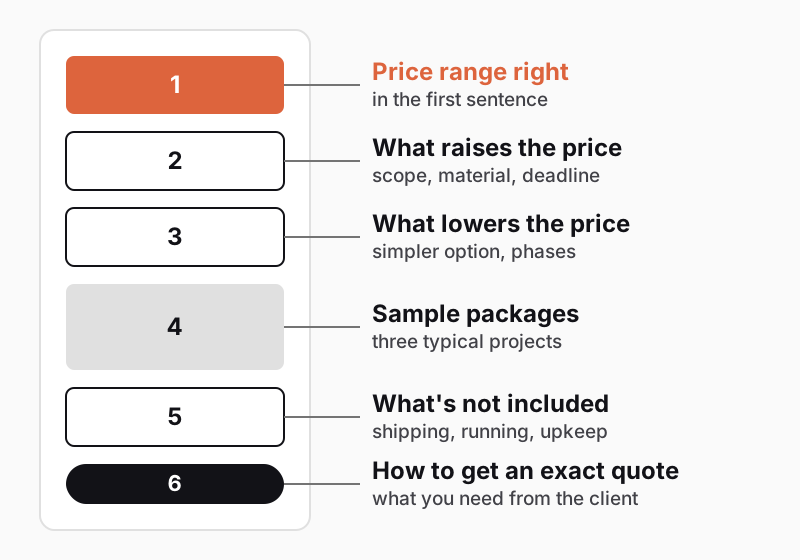
A pricing article should give a range, explain what changes the cost, and state what is excluded. Saying "it depends on your project" is not enough. Buyers need to know if they fit the budget—if you don't tell them, they keep looking.
Take River Pools. Their fiberglass pool pricing article (updated December 2025) gives ranges for three project tiers: basic installation, installation with a concrete patio, and a turnkey pool. It notes that basic quotes usually exclude electrical work, accessories, and decking, and separates upfront price from upkeep. Readers immediately know the ballpark and what to ask.
We do the same on our site. We list starting prices in our service price list: brochure websites from CZK 30,000, e-shops from CZK 140,000, web apps from CZK 230,000, business systems from CZK 180,000, and ad campaigns from CZK 40,000 per month. In our FAQ, we state that a complex website typically costs CZK 50,000 to 150,000, and break down the details in how much a website costs.
A pricing article has six parts:
Businesses often worry competitors will see their prices. Competitors usually know them anyway because buyers compare quotes. Publishing a range also filters out inquiries without a realistic budget. Worried the price will scare buyers off? It only scares off people who wouldn't buy anyway.
Writing about your solution's drawbacks builds trust—it shows you are not just writing ads. When you admit whom your service won't help, readers believe you when you say whom it pays off for. That goes double for custom services, where clients pay for something they cannot see yet.
Describe what can go wrong, how to prevent it, and how to fix it. A joiner explains maintaining wood around a sink, an accountant covers document deadlines, and a cosmetics shop explains why a new cream might initially irritate skin.
In comparisons, judge every option by the same criteria and end with situational advice: "If you cook daily and want zero upkeep, pick X; if you want a warm look and don't mind maintenance, pick Y." That helps far more than a vague "it depends."
Comparing solution types, materials, or methods is safer than naming competitors. If you name a company or product, you must follow comparative advertising laws—in Czechia, § 2980 of the Civil Code: comparisons must not mislead, must compare solutions for the same need, objectively evaluate relevant, verifiable features including price, and not disparage competitors. This summary is not legal advice; consult a lawyer before naming specific brands.
Wondering what to write on a company blog? Look for topics in customer questions and rank them by how closely they tie to your offer. Pull from three sources:
Score topics by business potential. In its keyword research guide, Ahrefs uses a 0–3 scale: 3 means your product is nearly irreplaceable, 2 means it helps a lot, 1 means a passing mention, and 0 means no fit at all. Prioritize 2s and 3s.
A solid content strategy pairs business potential with search volume. High volume with zero potential brings traffic without sales, while a score of 3 pays off even at a few searches a month because readers are ready to buy.
Example: a fictional joinery ranked six topics (search volume is a tool estimate, not actual data).
| Article topic | Potential (0–3) | Search volume | Priority |
|---|---|---|---|
| How much a custom kitchen costs | 3 | medium | 1 |
| Solid wood vs. laminate for kitchens | 3 | medium | 2 |
| How long kitchen manufacturing takes | 2 | low | 3 |
| How to choose a kitchen countertop | 2 | medium | 4 |
| How to care for wooden furniture | 1 | high | 5 |
| History of the joinery trade | 0 | low | skip |
Wood care brings readers, but few want a new kitchen. Save it until you have covered topics for ready-to-buy customers. Trade history does not belong in a lead-generation plan at all.
AI search answers pull specific facts—if your site lacks them, you won't be cited. Google launched AI Overviews in Czechia on May 20, 2025, placing them above regular results for many queries.
For broad questions, people often get their answer without clicking. In a July 2025 Pew Research Center study (March 2025 data from 900 US adults), users clicked a standard result in 8% of visits with an AI summary versus 15% without one. Only 1% clicked a link inside the AI summary itself.
AI easily summarizes a generic "What is a custom kitchen" post, so nobody visits your site. But when you share your actual price range, exclusions, and who it isn't for, you provide unique data. AI cites those specifics with a source link, giving readers a reason to click.
Google agrees: its helpful content guide rewards original information, added value, and firsthand experience. The Big 5 meet all three criteria because only you know your prices, pitfalls, and past projects. Read more in our articles:
Articles pay off most when your sales team uses them too, cutting down repetitive phone explanations:
Three-month plan (twelve articles, one per week ranked by business potential):
Track success by leads mentioning an article and Search Console queries, not social likes.
We plan content as part of our marketing campaigns. If you want help picking topics and building your first plan, contact us.
Content marketing is a way to win customers through useful content instead of direct ads. A business publishes articles, guides, videos, or comparisons that answer future buyers' questions. People find them in search engines while trying to solve a problem, building trust before they decide whom to call.
Five topics bring the most leads: cost and pricing, problems and drawbacks, comparisons, reviews, and "best of" lists. Find ideas in customer questions, Google Search Console queries, and Google's "People also ask" box. Start where your service is the natural solution.
In most industries, yes—at least a range or a "starting from" figure. Buyers always ask, and if you don't answer, a competitor will. When pricing depends on scope, explain what raises and lowers it, show sample projects, and list exclusions. A clear range also filters out inquiries that would never close.
Consistency beats volume. For a small business starting out, one solid article a week or two a month is enough. Rank topics by business potential—one honest pricing guide brings more leads than ten generic posts. Update older articles regularly, especially prices and dates.
Handpicked topics for you
Read our tips on boosting your search rankings and winning new customers for free
Read about the 7 emotions that drive people when buying goods or services, and which brands exemplify them.
Base your total spend on customer economics. For splitting brand and performance, IPA's 60:40 average is a useful guide. Track brand strength free in twenty minutes a month.
Before buying, customers search for prices, drawbacks, and comparisons. Here is how to answer them honestly on your website and pick topics that bring real inquiries.
Content marketing brings inquiries when your website honestly answers the questions buyers ask right before purchasing: what it costs, its drawbacks, how it differs from alternatives, and who it fits. Most companies dodge them. Whoever answers first and openly gains an edge that ads cannot buy.
In this article, we cover the They Ask, You Answer method, the five article types with the highest buying intent, and how to show pricing on your website even when it depends on the project. You will also learn what to write on a company blog, how to rank topics by business potential, why this matters even more with AI search, and get a three-month content strategy plan with a checklist.
Content marketing means winning customers through useful articles, guides, videos, or comparisons. Instead of writing about company anniversaries, you answer people trying to solve a problem who do not yet know whom to call.
Today, buyers research most things on their own before reaching out: ballpark prices, reviews, and comparisons. Companies with no answers on their site get quietly ruled out. We explain this in detail in our article on the buying consideration process.
American Marcus Sheridan, co-owner of Virginia fiberglass pool builder River Pools and Spas, documented this approach. According to his website, the company nearly went bankrupt during the 2008 crisis with no marketing budget. Sheridan honestly answered every question future pool owners asked on his site—covering prices, competitors, and common issues. Traffic and leads surged, turning a small builder into one of the world's most visited pool websites. In 2017, he published the book They Ask, You Answer.
The rule is simple: whatever customers ask, answer it on your site. Otherwise a competitor, a forum, or AI will. Think of a good hardware store clerk—they ask what you are fixing, not what you are buying. Customers return to whoever gives honest advice.
"The Big 5" bring the most inquiries: cost, problems, comparisons, reviews, and "best" lists. According to US agency Sidekick Strategies, these reflect searches made right before buying—anyone typing "how much does a custom kitchen cost" is seriously considering one.
Examples for a joinery workshop, a cosmetics e-shop, and an accounting firm:
| Article type | Joinery workshop | Cosmetics e-shop | Accounting firm |
|---|---|---|---|
| Cost | How much a custom kitchen costs | Monthly skincare routine cost | Accounting cost for an LLC |
| Problems | Drawbacks of solid wood kitchens | Why a face cream doesn't suit you | What an accountant won't do for you |
| Comparisons | Solid wood vs. laminate | Serum vs. cream | Accounting firm vs. in-house accountant |
| Reviews | A kitchen five years later | Three creams after one month | Accounting software for small businesses |
| Best | Best kitchen countertop | Best cream for sensitive skin | Best accounting software for freelancers |
None of these titles sound like an ad. Each answers a real search query and leads naturally to your offer. A joiner who explains the downsides of solid wood earns more trust than one who only praises it.
A pricing article should give a range, explain what changes the cost, and state what is excluded. Saying "it depends on your project" is not enough. Buyers need to know if they fit the budget—if you don't tell them, they keep looking.
Take River Pools. Their fiberglass pool pricing article (updated December 2025) gives ranges for three project tiers: basic installation, installation with a concrete patio, and a turnkey pool. It notes that basic quotes usually exclude electrical work, accessories, and decking, and separates upfront price from upkeep. Readers immediately know the ballpark and what to ask.
We do the same on our site. We list starting prices in our service price list: brochure websites from CZK 30,000, e-shops from CZK 140,000, web apps from CZK 230,000, business systems from CZK 180,000, and ad campaigns from CZK 40,000 per month. In our FAQ, we state that a complex website typically costs CZK 50,000 to 150,000, and break down the details in how much a website costs.
A pricing article has six parts:
Businesses often worry competitors will see their prices. Competitors usually know them anyway because buyers compare quotes. Publishing a range also filters out inquiries without a realistic budget. Worried the price will scare buyers off? It only scares off people who wouldn't buy anyway.
Writing about your solution's drawbacks builds trust—it shows you are not just writing ads. When you admit whom your service won't help, readers believe you when you say whom it pays off for. That goes double for custom services, where clients pay for something they cannot see yet.
Describe what can go wrong, how to prevent it, and how to fix it. A joiner explains maintaining wood around a sink, an accountant covers document deadlines, and a cosmetics shop explains why a new cream might initially irritate skin.
In comparisons, judge every option by the same criteria and end with situational advice: "If you cook daily and want zero upkeep, pick X; if you want a warm look and don't mind maintenance, pick Y." That helps far more than a vague "it depends."
Comparing solution types, materials, or methods is safer than naming competitors. If you name a company or product, you must follow comparative advertising laws—in Czechia, § 2980 of the Civil Code: comparisons must not mislead, must compare solutions for the same need, objectively evaluate relevant, verifiable features including price, and not disparage competitors. This summary is not legal advice; consult a lawyer before naming specific brands.
Wondering what to write on a company blog? Look for topics in customer questions and rank them by how closely they tie to your offer. Pull from three sources:
Score topics by business potential. In its keyword research guide, Ahrefs uses a 0–3 scale: 3 means your product is nearly irreplaceable, 2 means it helps a lot, 1 means a passing mention, and 0 means no fit at all. Prioritize 2s and 3s.
A solid content strategy pairs business potential with search volume. High volume with zero potential brings traffic without sales, while a score of 3 pays off even at a few searches a month because readers are ready to buy.
Example: a fictional joinery ranked six topics (search volume is a tool estimate, not actual data).
| Article topic | Potential (0–3) | Search volume | Priority |
|---|---|---|---|
| How much a custom kitchen costs | 3 | medium | 1 |
| Solid wood vs. laminate for kitchens | 3 | medium | 2 |
| How long kitchen manufacturing takes | 2 | low | 3 |
| How to choose a kitchen countertop | 2 | medium | 4 |
| How to care for wooden furniture | 1 | high | 5 |
| History of the joinery trade | 0 | low | skip |
Wood care brings readers, but few want a new kitchen. Save it until you have covered topics for ready-to-buy customers. Trade history does not belong in a lead-generation plan at all.
AI search answers pull specific facts—if your site lacks them, you won't be cited. Google launched AI Overviews in Czechia on May 20, 2025, placing them above regular results for many queries.
For broad questions, people often get their answer without clicking. In a July 2025 Pew Research Center study (March 2025 data from 900 US adults), users clicked a standard result in 8% of visits with an AI summary versus 15% without one. Only 1% clicked a link inside the AI summary itself.
AI easily summarizes a generic "What is a custom kitchen" post, so nobody visits your site. But when you share your actual price range, exclusions, and who it isn't for, you provide unique data. AI cites those specifics with a source link, giving readers a reason to click.
Google agrees: its helpful content guide rewards original information, added value, and firsthand experience. The Big 5 meet all three criteria because only you know your prices, pitfalls, and past projects. Read more in our articles:
Articles pay off most when your sales team uses them too, cutting down repetitive phone explanations:
Three-month plan (twelve articles, one per week ranked by business potential):
Track success by leads mentioning an article and Search Console queries, not social likes.
We plan content as part of our marketing campaigns. If you want help picking topics and building your first plan, contact us.
Content marketing is a way to win customers through useful content instead of direct ads. A business publishes articles, guides, videos, or comparisons that answer future buyers' questions. People find them in search engines while trying to solve a problem, building trust before they decide whom to call.
Five topics bring the most leads: cost and pricing, problems and drawbacks, comparisons, reviews, and "best of" lists. Find ideas in customer questions, Google Search Console queries, and Google's "People also ask" box. Start where your service is the natural solution.
In most industries, yes—at least a range or a "starting from" figure. Buyers always ask, and if you don't answer, a competitor will. When pricing depends on scope, explain what raises and lowers it, show sample projects, and list exclusions. A clear range also filters out inquiries that would never close.
Consistency beats volume. For a small business starting out, one solid article a week or two a month is enough. Rank topics by business potential—one honest pricing guide brings more leads than ten generic posts. Update older articles regularly, especially prices and dates.
Handpicked topics for you
Read our tips on boosting your search rankings and winning new customers for free
Read about the 7 emotions that drive people when buying goods or services, and which brands exemplify them.
Base your total spend on customer economics. For splitting brand and performance, IPA's 60:40 average is a useful guide. Track brand strength free in twenty minutes a month.