Content marketing: what to write so your blog brings leads
Before buying, customers search for prices, drawbacks, and comparisons. Here is how to answer them honestly on your website and pick topics that bring real inquiries.
AI Overviews, AI Mode, ChatGPT, and Seznam AI answer directly in search. See how they pick sources, what not to pay for, and what to fix in 30 days.

Pages that appear in answers from Google, ChatGPT, or Seznam AI (the Czech search engine's AI assistant) are those a search engine can crawl and display—and that answer clearly, specifically, and with backed-up facts. You do not need "GEO tricks" for AI search optimization: Google states in its documentation that AI Overviews and AI Mode require nothing beyond standard SEO.
Still, AI search changes traffic: sometimes people get an instant answer, other times they click a cited source. Here we explain what has changed in Czechia since 2025, how AI picks sources, what works, how to manage AI bots, common myths, and a 30-day plan for your website.
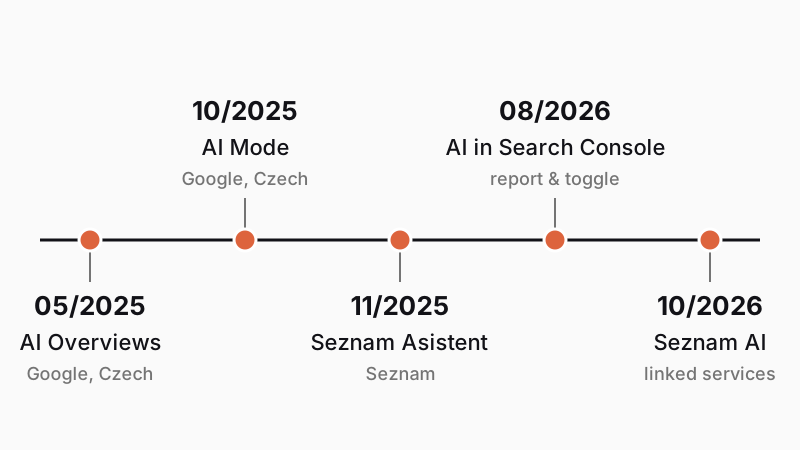
Over 18 months, three ways to search with AI arrived in Czechia. On May 20, 2025, Google launched Czech AI Overviews—summaries with links above search results. Starting October 7, 2025, it rolled out AI Mode, a separate tab for conversational queries that gives longer answers and follow-up suggestions.
Seznam, the main Czech search engine, introduced Seznam Asistent in November 2025 and opened it to all signed-in users in May 2026. As of October 2026, it is called Seznam AI and draws on Seznam search, news sites, Zboží.cz, Firmy.cz, TV listings, and newly Sreality.cz. Data from October 15, 2026, shows high hundreds of thousands of weekly users. If Seznam cannot find your site in its search index, you will not appear in its answers. We cover Seznam's market share and ad impact in Google Ads or Sklik.
The third way is assistants like OpenAI's ChatGPT or Google's Gemini, where people ask in full sentences. According to Google, AI Mode queries are two to three times longer than traditional searches.
What does this mean for you? Customers increasingly get a summary pulled from several sites. If you are missing from it, some buyers will never hear about your business—even if you have great services and reviews.
People click roughly half as much when an AI summary appears. A Pew Research Center study (March 2025, 900 US adults) found that when an AI summary appeared (18% of searches), clicks on standard results dropped from 15% to 8%. Only 1% clicked a link inside the summary, and 26% ended their session altogether, versus 16% without a summary. This is US data, though the trend is clear.
Google's Head of Search Liz Reid stated in August 2025 that total click volume is stable year over year, with more high-quality visits where users do not bounce right back. Still, she acknowledged some sites lose traffic while users click more on forums, videos, and podcasts.
What this means for businesses:
An AI answer does not come from a single page. Google uses query fan-out: it breaks a question (like "what flooring to put in a kitchen") into subtopics (durability, care, cost, installation), searches them in parallel, and builds an answer. Sites outside the top spots for the main query still have a chance.
Technical requirements to be cited:
Nobody outside these companies knows the exact selection algorithm, and Google states no external tool has access to its systems. It recommends first-hand expertise, original content written for people, and clear structure: claim, number, date, and source.
We write this blog the same way: each heading tackles a specific question, and every number has a source and date. Use this approach on service pages, pricing pages, and FAQs too.
Being a brand people write about helps most. In a December 2025 study, Ahrefs compared 75,000 brands across ChatGPT, AI Mode, and AI Overviews. Visibility correlated strongest with mentions on YouTube (around 0.74) and across the web (0.66 to 0.71), and only weakly with backlinks. Correlation measures parallel growth (1 = full, 0 = none).
Correlation is not causation: AI also mentions big brands because they are well known. Google warns in its AI search guide that unnatural mentions help very little. Do not buy them—earn them through media interviews, original cited data, and honest Google reviews.
What else helps your site get into AI answers:
We cover writing for customers and SEO basics in:
For most businesses, it pays to allow search bots and handle training bots separately. You control each by name in robots.txt at your site root (e.g., vasweb.cz/robots.txt), and blocking them has different effects.
| Bot in robots.txt | Operator | What blocking does |
|---|---|---|
| Googlebot | removes your site from Google Search, AI Overviews, and AI Mode | |
| Google-Extended | keeps content out of Gemini training and apps; Search is unaffected | |
| OAI-SearchBot | OpenAI | keeps your site out of ChatGPT search answers |
| GPTBot | OpenAI | keeps content out of OpenAI model training; ChatGPT search is unaffected |
| SeznamBot | Seznam.cz | removes your site from Seznam search and Seznam AI |
Google-Extended is not a crawler, just a token in robots.txt: Googlebot fetches the site, and the token only governs Gemini training and answers. It does not change search indexing or rankings, and it will not remove you from AI Overviews.
To opt out of those, use the Search generative AI control ("Search generative AI") in Search Console, available since August 31, 2026. Turning it off removes your impressions and visits from AI Overviews, AI Mode, and generative features in Discover. It does not affect standard rankings or model training, and takes effect in 1 to 2 days. Older directives like nosnippet, data-nosnippet, and max-snippet also restrict regular search snippets.
Watch out for ChatGPT-User: it opens pages on a user's request, and OpenAI notes robots.txt may not apply to it. OpenAI reflects robots.txt changes in search within roughly 24 hours.
Blocking makes sense if you sell the content itself (paid courses, databases, paywalled articles). For a typical company site or online store, blocking search bots only cuts visibility. Blocking training bots keeps visibility intact—it just stops future models from learning on your copy.
AI search has sparked plenty of unfounded promises. Before paying anyone, compare their pitch with what Google explicitly states:
| Myth | What Google actually says |
|---|---|
| You need an llms.txt file for AI | no special files or tags are needed; Google ignores them |
| An agency can guarantee citations in AI answers | no external tool has access to Google's systems; citations cannot be guaranteed |
| AI needs special structured data | not required for AI, and no special AI schema.org exists |
| Copy must be chopped into short chunks | chunking is unnecessary, and there is no ideal page length |
| GEO is a new field replacing SEO | optimizing for AI search is still SEO |
| More pages mean more citations | page count does not raise quality, and mass-generated content violates spam policies |
GEO (generative engine optimization) and AEO (answer engine optimization) refer to tweaks aimed at getting cited in AI answers. If someone pitches a standalone "GEO package," ask to see the work plan and how it differs from solid SEO.
Put your budget instead into clearer answers on existing pages, original data, honest reviews, and a fast, technically sound mobile-friendly site.
Track your AI search visibility in three ways:
After 30 days, you have baseline numbers, fixed site fundamentals, and a question list for ongoing work. AI results take time to shift, so repeat your check monthly. If you want to review an audit and plan with us, see our marketing campaigns or get in touch.
Google AI Overviews are summaries shown above search results. Google builds them from multiple websites with links, and they have worked in Czech since May 20, 2025. Sites appear without special tweaks—they just need to be indexed with text snippets allowed.
To appear in ChatGPT answers, check OAI-SearchBot first. If you block it in robots.txt, you will not show up. Once it has access, content decides: clear answers, dated facts, and a strong brand reputation. There is no guaranteed method, and nobody can promise citations.
Generative engine optimization (GEO) means adjusting a website for AI answers. According to Google, this is still standard SEO—you need no special files, tags, or writing style. A separate GEO package is usually unnecessary; solid SEO and original content do the job.
Do not block search crawlers like Googlebot, OAI-SearchBot, and SeznamBot, or you will disappear from search results and AI answers alike. You can block training bots (GPTBot, Google-Extended) without affecting search. You can also turn off AI Overviews and AI Mode in Search Console, though you will lose those impressions and visits.
Yes. AI Overviews and AI Mode pull from indexed pages with snippets allowed, and Google sets no extra requirements. A healthy website, useful content, and a strong brand work in both traditional and AI search at once.
Handpicked topics for you
Before buying, customers search for prices, drawbacks, and comparisons. Here is how to answer them honestly on your website and pick topics that bring real inquiries.
Read our tips on boosting your search rankings and winning new customers for free
Many businesses unknowingly break EU law or Google's rules when collecting reviews. Here is how to get honest reviews, reply to criticism, and handle fake ratings.
AI Overviews, AI Mode, ChatGPT, and Seznam AI answer directly in search. See how they pick sources, what not to pay for, and what to fix in 30 days.
Pages that appear in answers from Google, ChatGPT, or Seznam AI (the Czech search engine's AI assistant) are those a search engine can crawl and display—and that answer clearly, specifically, and with backed-up facts. You do not need "GEO tricks" for AI search optimization: Google states in its documentation that AI Overviews and AI Mode require nothing beyond standard SEO.
Still, AI search changes traffic: sometimes people get an instant answer, other times they click a cited source. Here we explain what has changed in Czechia since 2025, how AI picks sources, what works, how to manage AI bots, common myths, and a 30-day plan for your website.
Over 18 months, three ways to search with AI arrived in Czechia. On May 20, 2025, Google launched Czech AI Overviews—summaries with links above search results. Starting October 7, 2025, it rolled out AI Mode, a separate tab for conversational queries that gives longer answers and follow-up suggestions.
Seznam, the main Czech search engine, introduced Seznam Asistent in November 2025 and opened it to all signed-in users in May 2026. As of October 2026, it is called Seznam AI and draws on Seznam search, news sites, Zboží.cz, Firmy.cz, TV listings, and newly Sreality.cz. Data from October 15, 2026, shows high hundreds of thousands of weekly users. If Seznam cannot find your site in its search index, you will not appear in its answers. We cover Seznam's market share and ad impact in Google Ads or Sklik.
The third way is assistants like OpenAI's ChatGPT or Google's Gemini, where people ask in full sentences. According to Google, AI Mode queries are two to three times longer than traditional searches.
What does this mean for you? Customers increasingly get a summary pulled from several sites. If you are missing from it, some buyers will never hear about your business—even if you have great services and reviews.
People click roughly half as much when an AI summary appears. A Pew Research Center study (March 2025, 900 US adults) found that when an AI summary appeared (18% of searches), clicks on standard results dropped from 15% to 8%. Only 1% clicked a link inside the summary, and 26% ended their session altogether, versus 16% without a summary. This is US data, though the trend is clear.
Google's Head of Search Liz Reid stated in August 2025 that total click volume is stable year over year, with more high-quality visits where users do not bounce right back. Still, she acknowledged some sites lose traffic while users click more on forums, videos, and podcasts.
What this means for businesses:
An AI answer does not come from a single page. Google uses query fan-out: it breaks a question (like "what flooring to put in a kitchen") into subtopics (durability, care, cost, installation), searches them in parallel, and builds an answer. Sites outside the top spots for the main query still have a chance.
Technical requirements to be cited:
Nobody outside these companies knows the exact selection algorithm, and Google states no external tool has access to its systems. It recommends first-hand expertise, original content written for people, and clear structure: claim, number, date, and source.
We write this blog the same way: each heading tackles a specific question, and every number has a source and date. Use this approach on service pages, pricing pages, and FAQs too.
Being a brand people write about helps most. In a December 2025 study, Ahrefs compared 75,000 brands across ChatGPT, AI Mode, and AI Overviews. Visibility correlated strongest with mentions on YouTube (around 0.74) and across the web (0.66 to 0.71), and only weakly with backlinks. Correlation measures parallel growth (1 = full, 0 = none).
Correlation is not causation: AI also mentions big brands because they are well known. Google warns in its AI search guide that unnatural mentions help very little. Do not buy them—earn them through media interviews, original cited data, and honest Google reviews.
What else helps your site get into AI answers:
We cover writing for customers and SEO basics in:
For most businesses, it pays to allow search bots and handle training bots separately. You control each by name in robots.txt at your site root (e.g., vasweb.cz/robots.txt), and blocking them has different effects.
| Bot in robots.txt | Operator | What blocking does |
|---|---|---|
| Googlebot | removes your site from Google Search, AI Overviews, and AI Mode | |
| Google-Extended | keeps content out of Gemini training and apps; Search is unaffected | |
| OAI-SearchBot | OpenAI | keeps your site out of ChatGPT search answers |
| GPTBot | OpenAI | keeps content out of OpenAI model training; ChatGPT search is unaffected |
| SeznamBot | Seznam.cz | removes your site from Seznam search and Seznam AI |
Google-Extended is not a crawler, just a token in robots.txt: Googlebot fetches the site, and the token only governs Gemini training and answers. It does not change search indexing or rankings, and it will not remove you from AI Overviews.
To opt out of those, use the Search generative AI control ("Search generative AI") in Search Console, available since August 31, 2026. Turning it off removes your impressions and visits from AI Overviews, AI Mode, and generative features in Discover. It does not affect standard rankings or model training, and takes effect in 1 to 2 days. Older directives like nosnippet, data-nosnippet, and max-snippet also restrict regular search snippets.
Watch out for ChatGPT-User: it opens pages on a user's request, and OpenAI notes robots.txt may not apply to it. OpenAI reflects robots.txt changes in search within roughly 24 hours.
Blocking makes sense if you sell the content itself (paid courses, databases, paywalled articles). For a typical company site or online store, blocking search bots only cuts visibility. Blocking training bots keeps visibility intact—it just stops future models from learning on your copy.
AI search has sparked plenty of unfounded promises. Before paying anyone, compare their pitch with what Google explicitly states:
| Myth | What Google actually says |
|---|---|
| You need an llms.txt file for AI | no special files or tags are needed; Google ignores them |
| An agency can guarantee citations in AI answers | no external tool has access to Google's systems; citations cannot be guaranteed |
| AI needs special structured data | not required for AI, and no special AI schema.org exists |
| Copy must be chopped into short chunks | chunking is unnecessary, and there is no ideal page length |
| GEO is a new field replacing SEO | optimizing for AI search is still SEO |
| More pages mean more citations | page count does not raise quality, and mass-generated content violates spam policies |
GEO (generative engine optimization) and AEO (answer engine optimization) refer to tweaks aimed at getting cited in AI answers. If someone pitches a standalone "GEO package," ask to see the work plan and how it differs from solid SEO.
Put your budget instead into clearer answers on existing pages, original data, honest reviews, and a fast, technically sound mobile-friendly site.
Track your AI search visibility in three ways:
After 30 days, you have baseline numbers, fixed site fundamentals, and a question list for ongoing work. AI results take time to shift, so repeat your check monthly. If you want to review an audit and plan with us, see our marketing campaigns or get in touch.
Google AI Overviews are summaries shown above search results. Google builds them from multiple websites with links, and they have worked in Czech since May 20, 2025. Sites appear without special tweaks—they just need to be indexed with text snippets allowed.
To appear in ChatGPT answers, check OAI-SearchBot first. If you block it in robots.txt, you will not show up. Once it has access, content decides: clear answers, dated facts, and a strong brand reputation. There is no guaranteed method, and nobody can promise citations.
Generative engine optimization (GEO) means adjusting a website for AI answers. According to Google, this is still standard SEO—you need no special files, tags, or writing style. A separate GEO package is usually unnecessary; solid SEO and original content do the job.
Do not block search crawlers like Googlebot, OAI-SearchBot, and SeznamBot, or you will disappear from search results and AI answers alike. You can block training bots (GPTBot, Google-Extended) without affecting search. You can also turn off AI Overviews and AI Mode in Search Console, though you will lose those impressions and visits.
Yes. AI Overviews and AI Mode pull from indexed pages with snippets allowed, and Google sets no extra requirements. A healthy website, useful content, and a strong brand work in both traditional and AI search at once.
Handpicked topics for you
Before buying, customers search for prices, drawbacks, and comparisons. Here is how to answer them honestly on your website and pick topics that bring real inquiries.
Read our tips on boosting your search rankings and winning new customers for free
Many businesses unknowingly break EU law or Google's rules when collecting reviews. Here is how to get honest reviews, reply to criticism, and handle fake ratings.