
How much does a website cost: build and 3-year costs
A website can cost a few thousand or hundreds of thousands of CZK—and both make sense. See what drives the price, what three years of operation cost, and what to ask vendors.
Most new online stores only need a hosted platform. Learn how to spot when you outgrow it and when custom e-commerce is an unnecessary expense.

When choosing an e-commerce platform, most new stores do best with a hosted solution such as Shopify or Shoptet, the leading Czech hosted e-shop platform. You launch fast, the provider runs the infrastructure, and you only pay a monthly fee. Custom e-commerce pays off once you need individual B2B price lists, ERP integration, or an unusual checkout flow.
Here we explain the three operating models, a decision tree, signs you are outgrowing a hosted store, and rules for migrating safely. We build stores on both Shopify and custom stacks, so we know when custom development is an unnecessary expense.
You can run an online store in three ways: rent a hosted platform, use open-source software, or commission a custom build. They differ in what you own, upfront cost, and who handles operations.
Think of a physical store. A hosted platform is a mall unit: you get a ready-made space with maintenance, but you pay rent and follow house rules. Open source is a building kit: parts are free, while assembly and upkeep are on you. Custom development is your own building: you build exactly what you need, pay more upfront, and manage everything yourself.
| Model | What you own | Launch | Operations | Dependency |
|---|---|---|---|---|
| Hosted platform (Shoptet, Shopify) | data and domain, not software | fast and low-cost | monthly plan, provider runs infrastructure | platform rules and pricing |
| Open source (e.g., WooCommerce) | installation and data | moderate | you handle hosting, updates, and security | plugins and their authors |
| Custom build | solution per contract | highest cost and longest timeline | vendor maintenance and development | vendor, unless you own code and docs |
With a hosted store (SaaS), you pay a monthly fee. You get a ready-made setup with templates, admin tools, payments, and carriers, while the provider handles hosting, security, and updates. However, you can only change what the system allows, and you must accept price hikes or rule changes.
Open-source software (such as WooCommerce for WordPress) is free to download. You pay for hosting, plugins, and a specialist to set up, update, and secure the store. You get freedom to customize and can switch vendors without migrating data, but operations are your responsibility—and updates can break a store built from dozens of plugins.
Developers build a custom store around your exact workflows. It pays off when the store itself is a competitive advantage or connects deeply with internal systems. It is the slowest and most expensive route, so secure source code ownership and documentation in your contract from day one to avoid vendor lock-in.
As an example from the Czech market, a large share of local online stores run on Shoptet. In a September 2026 interview for Ekonom, its CEO Jan Hospodka estimated its share at over half of Czech stores by count and around 35 to 40 percent by turnover (Asian marketplaces cannot be measured precisely).
Plenty of freelancers and agencies know a leading domestic platform, so you do not depend on a single vendor. It also includes local Czech market specifics out of the box:
Global platforms like Shopify excel at multi-country sales and app ecosystems. However, local market requirements often need third-party apps or custom tweaks.
Feature count does not decide; fit with your store does. Test key workflows in a free trial using your own products.
Base your choice on your business model and three-year plan. The tree below covers the three main questions for initial orientation; verify the result against your actual workflows.
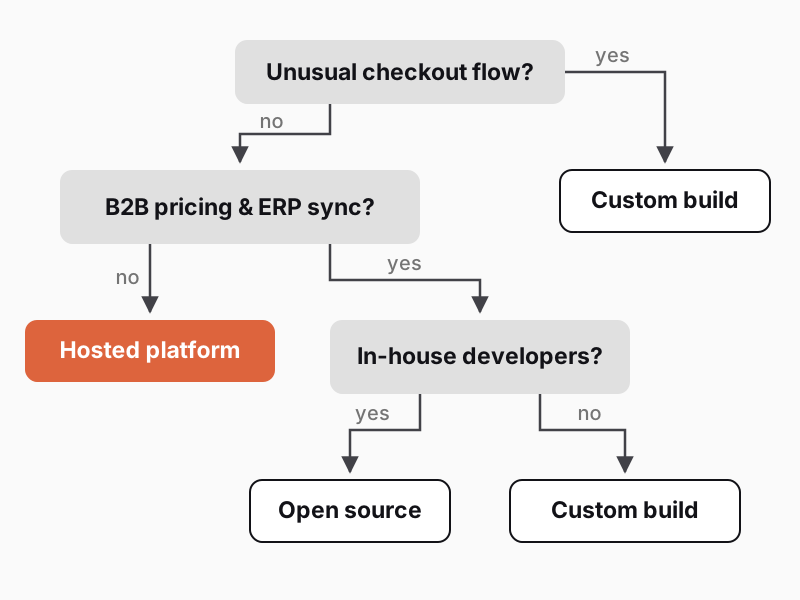
The first question checks your checkout flow. If customers configure products, book time slots, or ship directly to a service center, a hosted platform will force compromises. The second covers wholesale and ERP integration for inventory and accounting—custom B2B price lists and two-way stock sync are the top reasons companies leave hosted tools. The third separates open source from custom builds: open source makes sense when you have an in-house developer or a long-term technical partner.
Consider these points too:
A hosted store is plenty when you sell standard B2C goods in a single market like Czechia, need to launch within weeks, and manage the shop with a small team. You invest your budget into inventory, photos, and marketing instead of code.
Four items make up your costs: the monthly plan, payment fees, paid add-ons, and a theme or design tweaks. Official Czech pricing on November 13, 2026 looked like this:
| Platform | Monthly plans | What to keep in mind |
|---|---|---|
| Shoptet | Free CZK 0 (up to 10 products), Basic CZK 440, Business CZK 1,490, Profi CZK 2,490, Enterprise CZK 4,690, all excluding VAT | zero turnover commission, payment gateway and add-ons billed separately |
| Shopify | Basic CZK 499, Grow CZK 1,370, Advanced CZK 7,130 billed annually | 2%, 1%, or 0.6% transaction fee if not using Shopify Payments |
Under Shoptet pricing, you pay flat rent with no commission on sales, while card fees via ShoptetPay depend on your tier. Shopify pricing for Czechia lists plans in CZK (monthly billing costs more than annual) and adds a transaction fee unless you use Shopify Payments. Always check current price lists, as rates change.
At the start, an affordable ready-made theme with original photos and clear copy is usually enough, even if the layout resembles other stores. Custom graphics cost more upfront and occasionally need adjustments after major platform updates.
Add-ons often dictate the real operating cost: accounting sync, reviews, loyalty programs, translations, or smart filters. List the add-ons you need and add up their monthly fees before comparing platforms.
You are outgrowing a hosted platform when its limits cost time or money: your team uses manual workarounds, pays for dozens of clashing add-ons, or turns down orders the checkout cannot process.
A single issue is usually solved by a higher plan, an add-on, or an API integration that passes data between systems like a waiter between table and kitchen. With three or more connected issues, calculate what those limits cost: weekly hours spent retyping data, monthly add-on bills, and lost orders. Two people retyping orders five hours a week each equals over 500 hours a year—compare that against an integration or custom build amortized over several years. If shoppers drop off at checkout, UX may be to blame; check common reasons for cart abandonment first.
Shopify is a strong choice when you sell across multiple countries. According to the Shopify Help Center, a single store lets you manage markets, local currencies, domains, and translations, and Shopify Payments is available in Czechia too.
Domestic platforms are expanding as well. Shoptet lists 22 European markets (Hungary is live as of November 2026, with others in preparation) and 21 languages, and a translated storefront often suffices to test a foreign market quickly.
No hosted store handles tax compliance for you, though. Under European Commission rules effective July 1, 2021, cross-border B2C goods sales across the EU have an annual threshold of EUR 10,000 excluding VAT; above it, you remit VAT in the buyer's country via One Stop Shop (OSS). You configure rates in the store, but verify them with a tax advisor.
To sell in Czechia as an example of a local market on a global platform, you add local specifics via apps or custom code:
Before launch, verify that everything works together and agree on who maintains those integrations.
Choosing between Shoptet and Shopify is not just about monthly fees. Shopify shines in international sales and brand presentation, whereas a domestic platform is often more practical for selling solely in Czechia. Browse more of our work in the project portfolio.
Switching platforms risks lost data and search rankings from broken URLs:
/products and /collections paths.Never migrate right before peak season (such as Christmas), freeze major catalog or price changes, and agree on a fast rollback plan with your vendor. Related reading:
Considering custom e-commerce? Our online store builds start from CZK 140,000, and mid-sized projects take roughly 8–12 weeks. You can scope your store and get a non-binding estimate in our project configurator.
When deciding between Shoptet and Shopify, look at where you sell. Shoptet includes Czech carriers, parcel lockers, payments, and invoicing out of the box. Shopify is stronger internationally and offers an app ecosystem that can add Czech market specifics. Test both platforms with your own products.
A custom online store pays off when a hosted platform holds you back more than custom development costs. Typical triggers are B2B price lists, ERP integration, complex parameter search, or an unusual checkout flow. For a standard or brand-new store, it is unnecessary.
You pay a monthly plan, payment fees, add-ons, and theme tweaks. As of November 13, 2026, Shoptet runs from CZK 0 (up to 10 products) to CZK 4,690 per month excluding VAT, and Shopify starts at CZK 499 per month billed annually. Paid add-ons often drive the real total, so calculate them upfront.
Yes. Export and import your products, customers, orders, and reviews, map old URLs to new ones, and set up permanent redirects. Test the new store on a staging domain first, then monitor errors and search traffic closely after launch.
Handpicked topics for you
A website can cost a few thousand or hundreds of thousands of CZK—and both make sense. See what drives the price, what three years of operation cost, and what to ask vendors.
Seven in ten carts end without an order. Some shoppers just compare prices, while shipping costs, forced accounts, or missing parcel lockers stop others. Here is what to fix.
Typing orders into accounting by hand wastes time and breeds errors. See how to connect your systems, when a plugin is enough, and what to avoid.
Most new online stores only need a hosted platform. Learn how to spot when you outgrow it and when custom e-commerce is an unnecessary expense.
When choosing an e-commerce platform, most new stores do best with a hosted solution such as Shopify or Shoptet, the leading Czech hosted e-shop platform. You launch fast, the provider runs the infrastructure, and you only pay a monthly fee. Custom e-commerce pays off once you need individual B2B price lists, ERP integration, or an unusual checkout flow.
Here we explain the three operating models, a decision tree, signs you are outgrowing a hosted store, and rules for migrating safely. We build stores on both Shopify and custom stacks, so we know when custom development is an unnecessary expense.
You can run an online store in three ways: rent a hosted platform, use open-source software, or commission a custom build. They differ in what you own, upfront cost, and who handles operations.
Think of a physical store. A hosted platform is a mall unit: you get a ready-made space with maintenance, but you pay rent and follow house rules. Open source is a building kit: parts are free, while assembly and upkeep are on you. Custom development is your own building: you build exactly what you need, pay more upfront, and manage everything yourself.
| Model | What you own | Launch | Operations | Dependency |
|---|---|---|---|---|
| Hosted platform (Shoptet, Shopify) | data and domain, not software | fast and low-cost | monthly plan, provider runs infrastructure | platform rules and pricing |
| Open source (e.g., WooCommerce) | installation and data | moderate | you handle hosting, updates, and security | plugins and their authors |
| Custom build | solution per contract | highest cost and longest timeline | vendor maintenance and development | vendor, unless you own code and docs |
With a hosted store (SaaS), you pay a monthly fee. You get a ready-made setup with templates, admin tools, payments, and carriers, while the provider handles hosting, security, and updates. However, you can only change what the system allows, and you must accept price hikes or rule changes.
Open-source software (such as WooCommerce for WordPress) is free to download. You pay for hosting, plugins, and a specialist to set up, update, and secure the store. You get freedom to customize and can switch vendors without migrating data, but operations are your responsibility—and updates can break a store built from dozens of plugins.
Developers build a custom store around your exact workflows. It pays off when the store itself is a competitive advantage or connects deeply with internal systems. It is the slowest and most expensive route, so secure source code ownership and documentation in your contract from day one to avoid vendor lock-in.
As an example from the Czech market, a large share of local online stores run on Shoptet. In a September 2026 interview for Ekonom, its CEO Jan Hospodka estimated its share at over half of Czech stores by count and around 35 to 40 percent by turnover (Asian marketplaces cannot be measured precisely).
Plenty of freelancers and agencies know a leading domestic platform, so you do not depend on a single vendor. It also includes local Czech market specifics out of the box:
Global platforms like Shopify excel at multi-country sales and app ecosystems. However, local market requirements often need third-party apps or custom tweaks.
Feature count does not decide; fit with your store does. Test key workflows in a free trial using your own products.
Base your choice on your business model and three-year plan. The tree below covers the three main questions for initial orientation; verify the result against your actual workflows.
The first question checks your checkout flow. If customers configure products, book time slots, or ship directly to a service center, a hosted platform will force compromises. The second covers wholesale and ERP integration for inventory and accounting—custom B2B price lists and two-way stock sync are the top reasons companies leave hosted tools. The third separates open source from custom builds: open source makes sense when you have an in-house developer or a long-term technical partner.
Consider these points too:
A hosted store is plenty when you sell standard B2C goods in a single market like Czechia, need to launch within weeks, and manage the shop with a small team. You invest your budget into inventory, photos, and marketing instead of code.
Four items make up your costs: the monthly plan, payment fees, paid add-ons, and a theme or design tweaks. Official Czech pricing on November 13, 2026 looked like this:
| Platform | Monthly plans | What to keep in mind |
|---|---|---|
| Shoptet | Free CZK 0 (up to 10 products), Basic CZK 440, Business CZK 1,490, Profi CZK 2,490, Enterprise CZK 4,690, all excluding VAT | zero turnover commission, payment gateway and add-ons billed separately |
| Shopify | Basic CZK 499, Grow CZK 1,370, Advanced CZK 7,130 billed annually | 2%, 1%, or 0.6% transaction fee if not using Shopify Payments |
Under Shoptet pricing, you pay flat rent with no commission on sales, while card fees via ShoptetPay depend on your tier. Shopify pricing for Czechia lists plans in CZK (monthly billing costs more than annual) and adds a transaction fee unless you use Shopify Payments. Always check current price lists, as rates change.
At the start, an affordable ready-made theme with original photos and clear copy is usually enough, even if the layout resembles other stores. Custom graphics cost more upfront and occasionally need adjustments after major platform updates.
Add-ons often dictate the real operating cost: accounting sync, reviews, loyalty programs, translations, or smart filters. List the add-ons you need and add up their monthly fees before comparing platforms.
You are outgrowing a hosted platform when its limits cost time or money: your team uses manual workarounds, pays for dozens of clashing add-ons, or turns down orders the checkout cannot process.
A single issue is usually solved by a higher plan, an add-on, or an API integration that passes data between systems like a waiter between table and kitchen. With three or more connected issues, calculate what those limits cost: weekly hours spent retyping data, monthly add-on bills, and lost orders. Two people retyping orders five hours a week each equals over 500 hours a year—compare that against an integration or custom build amortized over several years. If shoppers drop off at checkout, UX may be to blame; check common reasons for cart abandonment first.
Shopify is a strong choice when you sell across multiple countries. According to the Shopify Help Center, a single store lets you manage markets, local currencies, domains, and translations, and Shopify Payments is available in Czechia too.
Domestic platforms are expanding as well. Shoptet lists 22 European markets (Hungary is live as of November 2026, with others in preparation) and 21 languages, and a translated storefront often suffices to test a foreign market quickly.
No hosted store handles tax compliance for you, though. Under European Commission rules effective July 1, 2021, cross-border B2C goods sales across the EU have an annual threshold of EUR 10,000 excluding VAT; above it, you remit VAT in the buyer's country via One Stop Shop (OSS). You configure rates in the store, but verify them with a tax advisor.
To sell in Czechia as an example of a local market on a global platform, you add local specifics via apps or custom code:
Before launch, verify that everything works together and agree on who maintains those integrations.
Choosing between Shoptet and Shopify is not just about monthly fees. Shopify shines in international sales and brand presentation, whereas a domestic platform is often more practical for selling solely in Czechia. Browse more of our work in the project portfolio.
Switching platforms risks lost data and search rankings from broken URLs:
/products and /collections paths.Never migrate right before peak season (such as Christmas), freeze major catalog or price changes, and agree on a fast rollback plan with your vendor. Related reading:
Considering custom e-commerce? Our online store builds start from CZK 140,000, and mid-sized projects take roughly 8–12 weeks. You can scope your store and get a non-binding estimate in our project configurator.
When deciding between Shoptet and Shopify, look at where you sell. Shoptet includes Czech carriers, parcel lockers, payments, and invoicing out of the box. Shopify is stronger internationally and offers an app ecosystem that can add Czech market specifics. Test both platforms with your own products.
A custom online store pays off when a hosted platform holds you back more than custom development costs. Typical triggers are B2B price lists, ERP integration, complex parameter search, or an unusual checkout flow. For a standard or brand-new store, it is unnecessary.
You pay a monthly plan, payment fees, add-ons, and theme tweaks. As of November 13, 2026, Shoptet runs from CZK 0 (up to 10 products) to CZK 4,690 per month excluding VAT, and Shopify starts at CZK 499 per month billed annually. Paid add-ons often drive the real total, so calculate them upfront.
Yes. Export and import your products, customers, orders, and reviews, map old URLs to new ones, and set up permanent redirects. Test the new store on a staging domain first, then monitor errors and search traffic closely after launch.
Handpicked topics for you
A website can cost a few thousand or hundreds of thousands of CZK—and both make sense. See what drives the price, what three years of operation cost, and what to ask vendors.
Seven in ten carts end without an order. Some shoppers just compare prices, while shipping costs, forced accounts, or missing parcel lockers stop others. Here is what to fix.
Typing orders into accounting by hand wastes time and breeds errors. See how to connect your systems, when a plugin is enough, and what to avoid.