Custom software, off-the-shelf, or no-code? How to choose
Off-the-shelf software covers most daily work. Build custom only what sets you apart. Use our quick test, see where no-code hits its ceiling, and compare five-year costs.
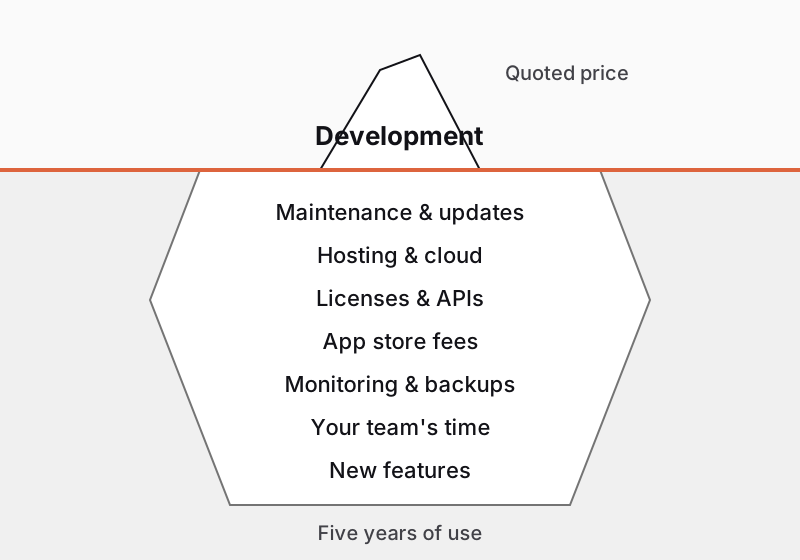
Development is just the tip of the iceberg. See what drives custom app pricing, what five years of operation and growth cost, and how to compare quotes.

No one can honestly quote an app development cost without a brief. Still, custom app pricing always comes down to scope, complexity, hourly rate, and a risk buffer. Development itself is just the tip of the iceberg. Over five years, app maintenance costs, operations, and new features can exceed the build price.
Instead of a vague price range, we show how to calculate software total cost of ownership (TCO). We explain price drivers, Czech rates, and hidden expenses, then model five-year costs across three scenarios. At the end, you get eight questions for vendors before signing a contract.
Custom app pricing comes from four variables: scope (what it does), complexity (how hard features and integrations are), the team's hourly rate, and a risk buffer. That is why quotes for the "same app" differ widely.
Scope is underestimated most often. Every feature hides questions: Who sees what? Should the app send emails or work offline? Each answer changes the effort.
Complexity hides in integrations (accounting, payments, inventory) and exceptions. Our article on connecting an e-shop to accounting shows how integrations work. Exceptions for specific customers or goods often cost more than the main workflow.
Uncertainty drops with preparation. Until details are clear, a vendor adds a buffer. Starting with a short paid discovery pays off: you get must-have and deferrable features, screen designs, integration specs, and an effort estimate. You can then easily compare quotes across vendors.
Timeline shapes cost too—small projects take weeks, mid-sized ones 8 to 12 weeks. Look for the shortest path to a first usable version.
A solid quote includes:
If anything is missing, check who does it and pays for it. We describe the full process in How web and mobile app development works.
Public rate data in Czechia is scarce. In an April 2026 Czech survey of communication agencies by the Association of Communication Agencies, hourly rates were CZK 2,042.52 for a developer, CZK 1,266.62 for a coder, and CZK 2,410.33 for a UX designer (AKA, 2026 Hourly Rate Survey Results). Treat these as rough guides: they are non-binding numbers from communication agencies (not software firms) for standard delivery, not strategy.
The lowest rate does not make the cheapest project. An experienced team with ready-made components finishes in 250 hours at CZK 2,000 for CZK 500,000. A cheaper team at CZK 1,500 spends 400 hours for CZK 600,000—and without tests leaves bugs you fix for a year. The figures are illustrative, but the rule holds: compare total price and scope.
When checking rates, ask:
We explain how risk splits in Fixed price vs. time and material.
Spending does not end at launch. Ongoing app maintenance costs and operations—updates, hosting, third-party services, store fees, new features, and staff time—can top the build price over five years.
37signals (makers of Basecamp) show how high operating costs run. In 2023 they left Amazon Web Services for their own servers to save roughly USD 10 million over five years (37signals, Cloud exit). Cloud pays off for a small app, but operations are never minor.
Cover operations with a service-level agreement (SLA). It sets outage response times, prepaid maintenance hours, and extra work rates. You get predictable monthly costs and priority help if the app goes down.
This model shows five-year costs based on how you maintain and grow the app. The numbers are illustrative assumptions, not a quote or market average—plug in your own:
| Five-year item | Lean | Standard | Growth |
|---|---|---|---|
| Development (one-off) | CZK 500,000 | CZK 500,000 | CZK 500,000 |
| Maintenance & updates | CZK 240,000 | CZK 600,000 | CZK 1,200,000 |
| Further development | CZK 0 | CZK 500,000 | CZK 1,500,000 |
| Hosting & services | CZK 60,000 | CZK 180,000 | CZK 600,000 |
| Five-year total | CZK 800,000 | CZK 1,780,000 | CZK 3,800,000 |
Over five years, operations make up over a third of total cost in the lean scenario. In standard, operations and growth pass double the build cost, and in growth over six times—though that means the app succeeded.
Three practical takeaways:
The calculation excludes your team's time and, for a mobile app, five years of Apple membership and the one-off Google Play registration.
An off-the-shelf system starts cheaper, but licenses grow with headcount. Custom app pricing starts high and grows slower. User count and lifespan set where the curves cross.
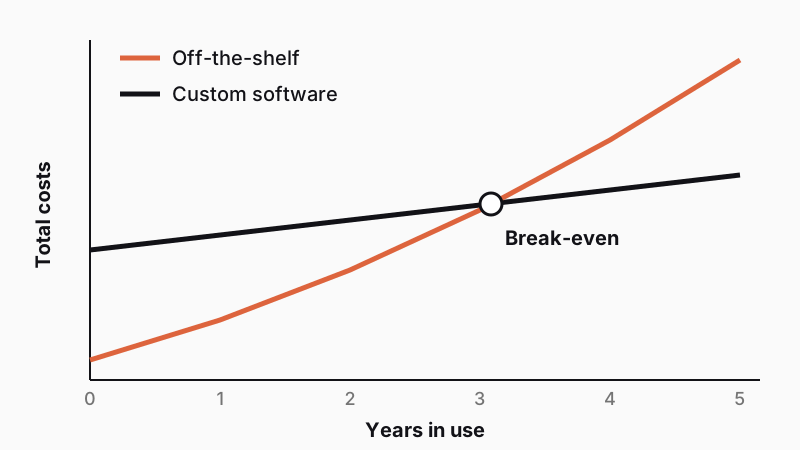
Calculate it yourself. For an off-the-shelf tool, multiply the monthly license by users and months (counting company growth) and add setup, add-ons, and tweaks. For custom software, sum build, operations, and growth. Compare totals after one, three, and five years.
Count exit costs too: data migration, parallel runs, and training for off-the-shelf tools, or code handover to another vendor for custom builds. Open data formats and solid documentation cut both.
Custom development pays off sooner when many people use the system (including customers and suppliers), your firm grows fast, or you need costly customizations. For a few people and standard workflows, pick an off-the-shelf tool.
It is not just about money. Custom software sets you apart from competitors, while off-the-shelf tools take routine admin off your hands. Read more in Custom software, off-the-shelf system, or no-code?.
Save on scope and process, not quality. A simple first version, ready-made parts, and one web app instead of two mobile apps save money. Cutting tests, security, and documentation costs more in repairs.
Where saving pays off:
Where not to cut corners:
Before signing a contract, ask about post-launch operating costs. A solid vendor answers specifically in writing.
Put the answers in a table and compare five-year costs, not just the build.
For reference:
Scope, platforms, and integrations set the price, so you cannot estimate it without a brief. Operations include Apple (USD 99/year), Google Play (USD 25 once), and updates for new iOS and Android versions. Without deep phone integration, a web app costs less.
A flat percentage is not enough. In our model, maintenance alone (maintenance hours times rate, without hosting, services, and development) runs CZK 48,000 to CZK 240,000 a year; add hosting, third-party services, and new features on top.
Vendors differ in how they read the brief, their rates, and their buffers—some include discovery, tests, and management, while others quote coding only. Ask for an itemized breakdown and exclusions, and compare five-year costs including operations.
A web app is built and maintained once with no store fees, and a progressive web app adds to the home screen. Native apps pay off for deep phone integration, offline work, or App Store and Google Play presence.
Handpicked topics for you
Off-the-shelf software covers most daily work. Build custom only what sets you apart. Use our quick test, see where no-code hits its ceiling, and compare five-year costs.
Fixed price looks safe, yet risk hides in a markup or change disputes. See why estimates are uncertain and how to pick a payment model for your project.
Step by step from initial design and tech stack selection to launch, optimization, and long-term maintenance
Development is just the tip of the iceberg. See what drives custom app pricing, what five years of operation and growth cost, and how to compare quotes.
No one can honestly quote an app development cost without a brief. Still, custom app pricing always comes down to scope, complexity, hourly rate, and a risk buffer. Development itself is just the tip of the iceberg. Over five years, app maintenance costs, operations, and new features can exceed the build price.
Instead of a vague price range, we show how to calculate software total cost of ownership (TCO). We explain price drivers, Czech rates, and hidden expenses, then model five-year costs across three scenarios. At the end, you get eight questions for vendors before signing a contract.
Custom app pricing comes from four variables: scope (what it does), complexity (how hard features and integrations are), the team's hourly rate, and a risk buffer. That is why quotes for the "same app" differ widely.
Scope is underestimated most often. Every feature hides questions: Who sees what? Should the app send emails or work offline? Each answer changes the effort.
Complexity hides in integrations (accounting, payments, inventory) and exceptions. Our article on connecting an e-shop to accounting shows how integrations work. Exceptions for specific customers or goods often cost more than the main workflow.
Uncertainty drops with preparation. Until details are clear, a vendor adds a buffer. Starting with a short paid discovery pays off: you get must-have and deferrable features, screen designs, integration specs, and an effort estimate. You can then easily compare quotes across vendors.
Timeline shapes cost too—small projects take weeks, mid-sized ones 8 to 12 weeks. Look for the shortest path to a first usable version.
A solid quote includes:
If anything is missing, check who does it and pays for it. We describe the full process in How web and mobile app development works.
Public rate data in Czechia is scarce. In an April 2026 Czech survey of communication agencies by the Association of Communication Agencies, hourly rates were CZK 2,042.52 for a developer, CZK 1,266.62 for a coder, and CZK 2,410.33 for a UX designer (AKA, 2026 Hourly Rate Survey Results). Treat these as rough guides: they are non-binding numbers from communication agencies (not software firms) for standard delivery, not strategy.
The lowest rate does not make the cheapest project. An experienced team with ready-made components finishes in 250 hours at CZK 2,000 for CZK 500,000. A cheaper team at CZK 1,500 spends 400 hours for CZK 600,000—and without tests leaves bugs you fix for a year. The figures are illustrative, but the rule holds: compare total price and scope.
When checking rates, ask:
We explain how risk splits in Fixed price vs. time and material.
Spending does not end at launch. Ongoing app maintenance costs and operations—updates, hosting, third-party services, store fees, new features, and staff time—can top the build price over five years.
37signals (makers of Basecamp) show how high operating costs run. In 2023 they left Amazon Web Services for their own servers to save roughly USD 10 million over five years (37signals, Cloud exit). Cloud pays off for a small app, but operations are never minor.
Cover operations with a service-level agreement (SLA). It sets outage response times, prepaid maintenance hours, and extra work rates. You get predictable monthly costs and priority help if the app goes down.
This model shows five-year costs based on how you maintain and grow the app. The numbers are illustrative assumptions, not a quote or market average—plug in your own:
| Five-year item | Lean | Standard | Growth |
|---|---|---|---|
| Development (one-off) | CZK 500,000 | CZK 500,000 | CZK 500,000 |
| Maintenance & updates | CZK 240,000 | CZK 600,000 | CZK 1,200,000 |
| Further development | CZK 0 | CZK 500,000 | CZK 1,500,000 |
| Hosting & services | CZK 60,000 | CZK 180,000 | CZK 600,000 |
| Five-year total | CZK 800,000 | CZK 1,780,000 | CZK 3,800,000 |
Over five years, operations make up over a third of total cost in the lean scenario. In standard, operations and growth pass double the build cost, and in growth over six times—though that means the app succeeded.
Three practical takeaways:
The calculation excludes your team's time and, for a mobile app, five years of Apple membership and the one-off Google Play registration.
An off-the-shelf system starts cheaper, but licenses grow with headcount. Custom app pricing starts high and grows slower. User count and lifespan set where the curves cross.
Calculate it yourself. For an off-the-shelf tool, multiply the monthly license by users and months (counting company growth) and add setup, add-ons, and tweaks. For custom software, sum build, operations, and growth. Compare totals after one, three, and five years.
Count exit costs too: data migration, parallel runs, and training for off-the-shelf tools, or code handover to another vendor for custom builds. Open data formats and solid documentation cut both.
Custom development pays off sooner when many people use the system (including customers and suppliers), your firm grows fast, or you need costly customizations. For a few people and standard workflows, pick an off-the-shelf tool.
It is not just about money. Custom software sets you apart from competitors, while off-the-shelf tools take routine admin off your hands. Read more in Custom software, off-the-shelf system, or no-code?.
Save on scope and process, not quality. A simple first version, ready-made parts, and one web app instead of two mobile apps save money. Cutting tests, security, and documentation costs more in repairs.
Where saving pays off:
Where not to cut corners:
Before signing a contract, ask about post-launch operating costs. A solid vendor answers specifically in writing.
Put the answers in a table and compare five-year costs, not just the build.
For reference:
Scope, platforms, and integrations set the price, so you cannot estimate it without a brief. Operations include Apple (USD 99/year), Google Play (USD 25 once), and updates for new iOS and Android versions. Without deep phone integration, a web app costs less.
A flat percentage is not enough. In our model, maintenance alone (maintenance hours times rate, without hosting, services, and development) runs CZK 48,000 to CZK 240,000 a year; add hosting, third-party services, and new features on top.
Vendors differ in how they read the brief, their rates, and their buffers—some include discovery, tests, and management, while others quote coding only. Ask for an itemized breakdown and exclusions, and compare five-year costs including operations.
A web app is built and maintained once with no store fees, and a progressive web app adds to the home screen. Native apps pay off for deep phone integration, offline work, or App Store and Google Play presence.
Handpicked topics for you
Off-the-shelf software covers most daily work. Build custom only what sets you apart. Use our quick test, see where no-code hits its ceiling, and compare five-year costs.
Fixed price looks safe, yet risk hides in a markup or change disputes. See why estimates are uncertain and how to pick a payment model for your project.
Step by step from initial design and tech stack selection to launch, optimization, and long-term maintenance