App development cost and five-year operating costs
Development is just the tip of the iceberg. See what drives custom app pricing, what five years of operation and growth cost, and how to compare quotes.
Fixed price looks safe, yet risk hides in a markup or change disputes. See why estimates are uncertain and how to pick a payment model for your project.

Fixed price vs time and material? A fixed price gives budget certainty, yet you pay for risk through a markup or change disputes. Time & material (paying for work done) is more flexible, though it needs your active management. Your choice depends on how clearly you know today what you want to build.
We explain why software estimation is uncertain, how software development pricing models work, what the Civil Code says, and how to read a quote. This text covers general principles, not legal advice.
Software estimation is uncertain because a custom app is not built from a finished drawing like a joiner's tenth identical kitchen. Each time it solves a different process and connects to different systems.
What nobody knows yet costs the most: How do you handle a partial order return? What if a customer changes the address after shipping? Will your accounting software accept data automatically? Each question can add a day or a week of work. Without answers, an estimate is just a guess.
It is like renovating an old house: you only see what is under the plaster once you open the walls. Honest site managers and software vendors therefore talk about a price range and what they must inspect first.
We also tend to underestimate the time and cost of our own plans. Psychologists Daniel Kahneman and Amos Tversky called this the planning fallacy in 1979. Both vendors and clients fall for it.
The cone of uncertainty shows potential estimation error across project phases. At the idea stage, reality can be four times higher or four times lower than the estimate—a sixteenfold spread (Construx, Steve McConnell).
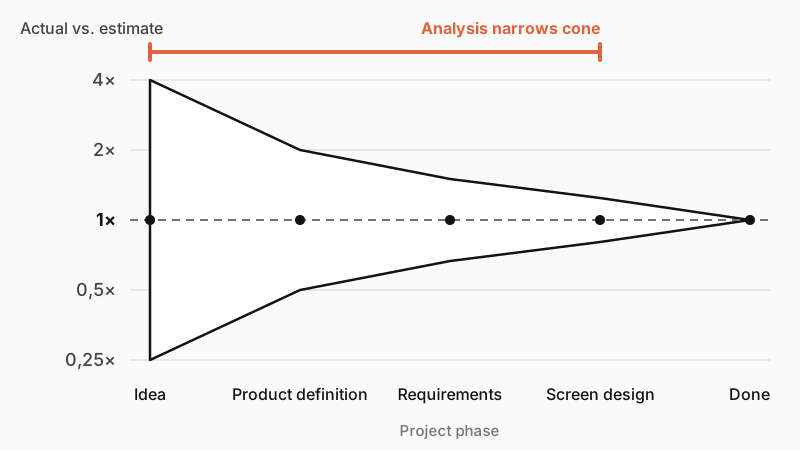
According to McConnell, the cone narrows sharply during the first 20 to 30% of project time if you decide what the product will and won't do and how screens look. A vendor cannot sharpen an estimate alone at a desk; only joint decisions do that. A fixed price at the idea stage is a bet with a twofold to fourfold error, and without active management, uncertainty never drops.
Five questions show where you sit in the cone:
The more "no" answers, the wider the range to expect. That is why we recommend paying separately for initial discovery to settle these questions. Our method has four phases (Research, Design, Development, and Launch), and the first two cut uncertainty before the costliest work begins.
An analysis of 1,471 IT projects by Bent Flyvbjerg and Alexander Budzier found an average cost overrun of 27%. Yet one in six projects was a black swan: an unexpected high-impact event that raised budgets by 200% on average and schedules by nearly 70% (Flyvbjerg and Budzier, Harvard Business Review, September 2011). In software, this is often a tricky legacy integration, a law change, or finding a key company process works differently.
How to protect yourself:
A fixed price means the vendor delivers the agreed scope for a set sum, even if the work costs them more. They carry the risk and build a risk markup into the price. You pay it even if everything goes smoothly.
Under a contract for work, the Czech Civil Code (Act No. 89/2012 Coll.) protects a fixed price. Under Section 2620, neither party can claim a price change just because the work took different effort or cost; only truly extraordinary circumstances decided by a court are exempt. With a non-binding budget under Section 2622, the vendor may claim an increase if announced without delay. If they ask for over 10% above budget, you may withdraw (Act No. 89/2012 Coll., effective Jan 1, 2026).
What to watch out for with a fixed price:
How to reduce these risks:
Fixed price fits a small, tightly defined scope: a brochure website from a finished design, linking two systems with a clear interface, or a phase following discovery.
With time & material (T&M), you pay for actual work done: hours or man-days (MD, usually eight hours by one person) times a rate, plus any licenses. You pay no risk markup, though you carry the risk.
Flexibility is the main benefit. You can shift priorities weekly and pay only for work actually done. It fits products still taking shape and long-term growth.
Time & material works only under three conditions:
The Czech Civil Code does not require a set sum in a contract for work. Under Section 2586, agreeing on how to calculate the price or an estimate suffices. State the rate, reporting, and work approval clearly in your software contract, and review the contract form with a lawyer.
A budget cap per phase or month is a solid safeguard. As work nears the cap, the vendor alerts you so you can fit scope to budget.
A man-day or hourly rate depends on developer seniority, tech stack, liability, and contract terms. An April 2026 survey by the Association of Communication Agencies puts an agency programmer's hourly rate at CZK 2,042.52 (AKA, 2026). Software firms and freelancers charge differently, so always check what the price includes.
Several combinations sit between pure fixed price and time & material:
| Model | Budget certainty | Flexibility | Risk carried by | Best for |
|---|---|---|---|---|
| Fixed price | high | low | vendor (for a markup) | small, tightly defined scope |
| Time & material | low | high | client | product still taking shape |
| Capped T&M | medium | high up to cap | both sides | tight budget, open scope |
| Paid discovery and fixed phases | high per phase | medium | both sides per phase | most custom development |
| Monthly capacity | high (monthly) | high | client | long-term growth and maintenance |
| Fixed time, variable scope | high | within scope | both sides | clearly prioritized features |
Paid discovery and fixed phases are the safest route. You pay for discovery first, then order individual phases at a fixed price based on finished specs. After each phase, you decide what comes next.
Monthly capacity means booking a fixed number of man-days per month while the team works to your priorities. It fits post-launch growth.
Take a fictional joinery ordering a job-management app:
Fixed time with variable scope comes from Basecamp's Shape Up method. First you set your appetite—how much time a feature is worth to you. Estimates start with a design and end with a number, whereas appetite starts with a number and ends with a design (Basecamp, Shape Up). Basecamp works in six-week cycles (1–2 weeks for smaller tasks). Scope adapts to time and the budget stays fixed.
A good quote admits uncertainty and explains how it handles it. One exact number without assumptions hides a steep risk markup, or the difference appears later in change requests.
Red flags:
Four key terms:
Code ownership decides whether you can switch vendors. Read more in our related articles:
We build custom web apps from CZK 230,000. For an initial view of scope and price, try our project configurator, which turns your answers into a brief and three solution options.
With time and material (T&M), you pay for actual work done: hours or man-days times a rate, plus costs like licenses. You can change priorities as you go. Because you carry the risk of longer work, regular priorities, clear timesheets, and a budget cap are essential.
Choosing fixed price vs time and material depends on your brief. Fixed price pays off for a small, tightly defined scope. With vague specs, a risk markup and extra paid changes drive the cost up. Under Section 2620 of the Czech Civil Code, a fixed price cannot change just due to higher effort. Paid discovery followed by fixed phases usually works best.
Software estimation misses the mark because nobody knows all details up front and people naturally underestimate time and cost. Under Steve McConnell's cone of uncertainty, actual cost at the idea stage differs up to fourfold. Only scope decisions—such as during discovery—sharpen an estimate.
Pre-development discovery defines goals, processes, requirements, and main screens. You pay for it separately because it delivers a finished brief for a much sharper estimate. If your contract states the brief belongs to you, you can take it to another vendor too.
Handpicked topics for you
Development is just the tip of the iceberg. See what drives custom app pricing, what five years of operation and growth cost, and how to compare quotes.
Off-the-shelf software covers most daily work. Build custom only what sets you apart. Use our quick test, see where no-code hits its ceiling, and compare five-year costs.
Step by step from initial design and tech stack selection to launch, optimization, and long-term maintenance
Fixed price looks safe, yet risk hides in a markup or change disputes. See why estimates are uncertain and how to pick a payment model for your project.
Fixed price vs time and material? A fixed price gives budget certainty, yet you pay for risk through a markup or change disputes. Time & material (paying for work done) is more flexible, though it needs your active management. Your choice depends on how clearly you know today what you want to build.
We explain why software estimation is uncertain, how software development pricing models work, what the Civil Code says, and how to read a quote. This text covers general principles, not legal advice.
Software estimation is uncertain because a custom app is not built from a finished drawing like a joiner's tenth identical kitchen. Each time it solves a different process and connects to different systems.
What nobody knows yet costs the most: How do you handle a partial order return? What if a customer changes the address after shipping? Will your accounting software accept data automatically? Each question can add a day or a week of work. Without answers, an estimate is just a guess.
It is like renovating an old house: you only see what is under the plaster once you open the walls. Honest site managers and software vendors therefore talk about a price range and what they must inspect first.
We also tend to underestimate the time and cost of our own plans. Psychologists Daniel Kahneman and Amos Tversky called this the planning fallacy in 1979. Both vendors and clients fall for it.
The cone of uncertainty shows potential estimation error across project phases. At the idea stage, reality can be four times higher or four times lower than the estimate—a sixteenfold spread (Construx, Steve McConnell).
According to McConnell, the cone narrows sharply during the first 20 to 30% of project time if you decide what the product will and won't do and how screens look. A vendor cannot sharpen an estimate alone at a desk; only joint decisions do that. A fixed price at the idea stage is a bet with a twofold to fourfold error, and without active management, uncertainty never drops.
Five questions show where you sit in the cone:
The more "no" answers, the wider the range to expect. That is why we recommend paying separately for initial discovery to settle these questions. Our method has four phases (Research, Design, Development, and Launch), and the first two cut uncertainty before the costliest work begins.
An analysis of 1,471 IT projects by Bent Flyvbjerg and Alexander Budzier found an average cost overrun of 27%. Yet one in six projects was a black swan: an unexpected high-impact event that raised budgets by 200% on average and schedules by nearly 70% (Flyvbjerg and Budzier, Harvard Business Review, September 2011). In software, this is often a tricky legacy integration, a law change, or finding a key company process works differently.
How to protect yourself:
A fixed price means the vendor delivers the agreed scope for a set sum, even if the work costs them more. They carry the risk and build a risk markup into the price. You pay it even if everything goes smoothly.
Under a contract for work, the Czech Civil Code (Act No. 89/2012 Coll.) protects a fixed price. Under Section 2620, neither party can claim a price change just because the work took different effort or cost; only truly extraordinary circumstances decided by a court are exempt. With a non-binding budget under Section 2622, the vendor may claim an increase if announced without delay. If they ask for over 10% above budget, you may withdraw (Act No. 89/2012 Coll., effective Jan 1, 2026).
What to watch out for with a fixed price:
How to reduce these risks:
Fixed price fits a small, tightly defined scope: a brochure website from a finished design, linking two systems with a clear interface, or a phase following discovery.
With time & material (T&M), you pay for actual work done: hours or man-days (MD, usually eight hours by one person) times a rate, plus any licenses. You pay no risk markup, though you carry the risk.
Flexibility is the main benefit. You can shift priorities weekly and pay only for work actually done. It fits products still taking shape and long-term growth.
Time & material works only under three conditions:
The Czech Civil Code does not require a set sum in a contract for work. Under Section 2586, agreeing on how to calculate the price or an estimate suffices. State the rate, reporting, and work approval clearly in your software contract, and review the contract form with a lawyer.
A budget cap per phase or month is a solid safeguard. As work nears the cap, the vendor alerts you so you can fit scope to budget.
A man-day or hourly rate depends on developer seniority, tech stack, liability, and contract terms. An April 2026 survey by the Association of Communication Agencies puts an agency programmer's hourly rate at CZK 2,042.52 (AKA, 2026). Software firms and freelancers charge differently, so always check what the price includes.
Several combinations sit between pure fixed price and time & material:
| Model | Budget certainty | Flexibility | Risk carried by | Best for |
|---|---|---|---|---|
| Fixed price | high | low | vendor (for a markup) | small, tightly defined scope |
| Time & material | low | high | client | product still taking shape |
| Capped T&M | medium | high up to cap | both sides | tight budget, open scope |
| Paid discovery and fixed phases | high per phase | medium | both sides per phase | most custom development |
| Monthly capacity | high (monthly) | high | client | long-term growth and maintenance |
| Fixed time, variable scope | high | within scope | both sides | clearly prioritized features |
Paid discovery and fixed phases are the safest route. You pay for discovery first, then order individual phases at a fixed price based on finished specs. After each phase, you decide what comes next.
Monthly capacity means booking a fixed number of man-days per month while the team works to your priorities. It fits post-launch growth.
Take a fictional joinery ordering a job-management app:
Fixed time with variable scope comes from Basecamp's Shape Up method. First you set your appetite—how much time a feature is worth to you. Estimates start with a design and end with a number, whereas appetite starts with a number and ends with a design (Basecamp, Shape Up). Basecamp works in six-week cycles (1–2 weeks for smaller tasks). Scope adapts to time and the budget stays fixed.
A good quote admits uncertainty and explains how it handles it. One exact number without assumptions hides a steep risk markup, or the difference appears later in change requests.
Red flags:
Four key terms:
Code ownership decides whether you can switch vendors. Read more in our related articles:
We build custom web apps from CZK 230,000. For an initial view of scope and price, try our project configurator, which turns your answers into a brief and three solution options.
With time and material (T&M), you pay for actual work done: hours or man-days times a rate, plus costs like licenses. You can change priorities as you go. Because you carry the risk of longer work, regular priorities, clear timesheets, and a budget cap are essential.
Choosing fixed price vs time and material depends on your brief. Fixed price pays off for a small, tightly defined scope. With vague specs, a risk markup and extra paid changes drive the cost up. Under Section 2620 of the Czech Civil Code, a fixed price cannot change just due to higher effort. Paid discovery followed by fixed phases usually works best.
Software estimation misses the mark because nobody knows all details up front and people naturally underestimate time and cost. Under Steve McConnell's cone of uncertainty, actual cost at the idea stage differs up to fourfold. Only scope decisions—such as during discovery—sharpen an estimate.
Pre-development discovery defines goals, processes, requirements, and main screens. You pay for it separately because it delivers a finished brief for a much sharper estimate. If your contract states the brief belongs to you, you can take it to another vendor too.
Handpicked topics for you
Development is just the tip of the iceberg. See what drives custom app pricing, what five years of operation and growth cost, and how to compare quotes.
Off-the-shelf software covers most daily work. Build custom only what sets you apart. Use our quick test, see where no-code hits its ceiling, and compare five-year costs.
Step by step from initial design and tech stack selection to launch, optimization, and long-term maintenance