How much does a website cost: build and 3-year costs
A website can cost a few thousand or hundreds of thousands of CZK—and both make sense. See what drives the price, what three years of operation cost, and what to ask vendors.
Paid for a website, yet your former developer holds the domain and logins? See what to register to your company, what to put in your contract, and how to get it back.
Who owns a website? It belongs to your company only when the domain, hosting, and all accounts are in its name, and your contract grants a license to use, edit, and move the site to another vendor. A paid invoice alone does not guarantee ownership.
Here we explain what makes up a website, how domain registrants and registrars work, how website copyright applies, which logins you must hold, and how to get your site back. Domain registries and copyright laws differ by country; we use Czech law and .cz registry rules as of November 13, 2026 as our example, not as legal advice.
You usually find out when switching vendors. Your new developer asks for domain and admin logins, only to discover the domain is registered to your former developer, their firm pays for hosting, and only they know the passwords.
Picture a fictional joinery in Kolín whose website was built by an acquaintance. Out of goodwill and convenience, he registered everything in his own name. Today he is unreachable, and the company cannot even change a line of text on its homepage.
Without source code and a license, a business sometimes has to rebuild its site from scratch. It can lose search history, traffic data, form leads, and past emails. And if the domain expires, both the website and company email stop working.
A simple audit prevents all of this. You just need to know the parts of a website and where the owner of each part is recorded.
A website consists of a domain, DNS settings, hosting, a content management system (CMS), source code, graphics, copy, photos, customer data, and accounts with Google or other services.
Think of it as a storefront: the domain is the street address, hosting is the leased space, code and design are the fixtures, data is the customer file, and accounts are the door keys. When moving, you need the lease in your name, your own fixtures, and every key.
| Website part | Who should hold it | What the vendor may do |
|---|---|---|
| Domain | Your company as registrant | Manage DNS on your instruction |
| Hosting | Company contract, or handover agreement | Manage the server |
| CMS and code | License or rights per contract, code with you | Develop and deploy updates |
| Design, copy, photos | License, source files with you | Create and edit |
| Customer data | You as data controller | Process under contract |
| Google and ad accounts | Company account as owner | Work via an assigned role |
| Domain email | Company admin account | Help with setup |
The core distinction is between ownership and access. Your company should own all accounts, the domain, and the data. Grant your vendor working permissions only, then revoke them once your collaboration ends.
Watch customer data from forms or your e-shop too. You are the data controller, while any vendor with access is a processor. Under Article 28 of the GDPR, you must have a data processing agreement with them.
A domain belongs to the registrant listed in its central registry—for .cz domains, that is CZ.NIC (other extensions follow their own registries' rules). A registrar is simply the provider where you register, pay for, and update the domain. Under the .cz Domain Name Registration Rules effective January 20, 2026, only the registrant may use and manage the domain.
It works like a land registry: CZ.NIC keeps the register, the registrant is the owner, and the registrar files updates. Who pays the renewal invoice does not matter. Paying a developer who holds the domain in their own name means paying for their domain.
The registrant record must include your company name. If left blank, the named individual is the registrant (Art. 2.2.16 of the rules)—so a domain listing only a managing director's name belongs to them personally, not the company.
How do you transfer domain ownership? CZ.NIC processes it through the designated registrar only upon a written request from both the current and future registrants (Art. 7.1 of the rules). Without the current registrant's consent, such as a former developer's, you cannot transfer the domain unless a court or dispute panel orders it.
Switching registrars starts with the new registrar and is confirmed by the registrant or administrative contact (Annex 2 of the rules) using an authinfo password. If your current registrar withholds it, request it directly from CZ.NIC via the Requests form. If your email matches the registry contact, CZ.NIC sends it automatically. Always keep an active company email listed there.
Also check the administrative contact (who can change registrars and nameservers) and expiration date. Unrenewed .cz domains enter a 60-day protection period: after 30 days CZ.NIC may disable your site and email (cancel delegation), and after 60 days registration expires (Art. 8.2 of the rules).
We explain how domains, hosting, and DNS fit together in What a domain and hosting server are.
Copyright rules differ by country; in the Czech Republic, you cannot buy website copyright outright. Under Section 26 of the Czech Copyright Act, an author's economic rights are non-transferable. Instead, you get a license—permission to use the work. What matters most is whether you may modify the site (even with another vendor) and whether the license is unlimited.
When a Czech contract for work says nothing about licensing, statutory defaults apply:
For custom-ordered source code, the client exercises economic rights (Section 58(7) of the Copyright Act), though this excludes graphics, copy, and photos. Moreover, if an agency built the site using employees, existing libraries, templates, or older modules, you get only the license your contract secures. As law firm Sedlakova Legal noted in October 2026, code belongs to whoever exercises economic rights to it, not whoever paid for it.
Under Section 66 of the Copyright Act, you may fix bugs and make changes needed to run the program. Further development by another vendor, however, requires an explicit license.
Website logins must belong to your company, with your vendor holding separate access that you revoke afterward. Stick to three rules:
Take Google Search Console, which separates owners and users. Per Google Help, you add or remove a verified owner only via a site token (such as in DNS). Whoever controls the domain can always verify ownership.
Reviewing this keyring takes an hour. Repeat it once a year and whenever an employee or vendor leaves.
Five contract clauses prevent most disputes:
If the vendor handles customer data, add a data processing agreement. We cover billing models in Fixed price vs. time and material and total costs including maintenance in How much a website costs.
Discuss these points before choosing a vendor. For a business website, one meeting saves plenty of trouble later.
Recovery takes three steps: check your status, request handover in writing, and escalate if needed. Step two is often enough—the vendor is simply waiting for a formal request.
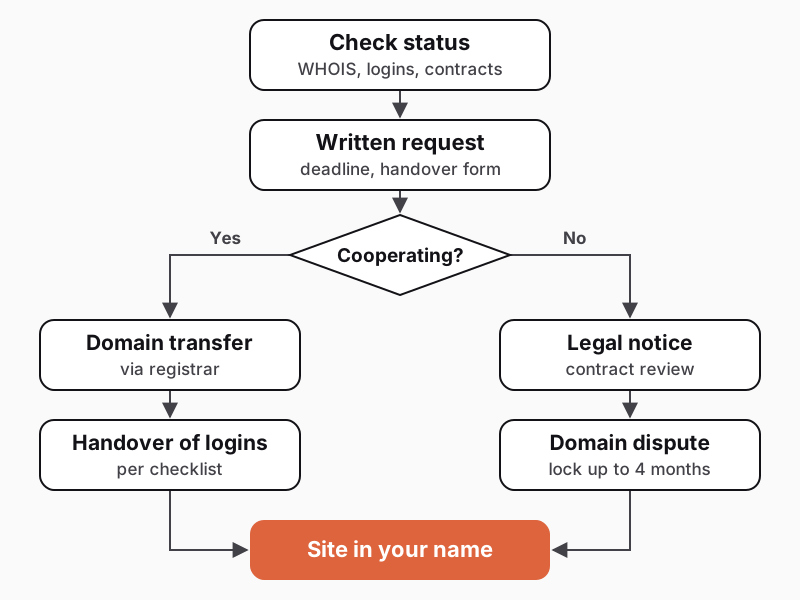
Check your status. Verify the domain registrant in WHOIS. Map out where hosting runs, who owns Google and ad accounts, and which website logins you hold. Gather contracts, orders, and emails.
Request handover in writing. Send an itemized list, a fair deadline, and a handover record. Changing a domain registrant requires both parties' request via the registrar. In Google accounts, the vendor simply sets you as owner and removes themselves.
Escalate the dispute. If a .cz domain contains your company name or trademark, out-of-court .cz dispute resolution helps (run for CZ.NIC by the Arbitration Court attached to the Czech Chamber of Commerce and the Agricultural Chamber). It can transfer or cancel the domain. Once filed, ask CZ.NIC for a four-month block (Art. 20 of the rules). A lawyer can assist with licenses, code, and data.
With DNS access, you can verify Search Console yourself. You can also build a new site in parallel—just set up redirects per Website redesign without losing traffic.
Unsure whether your website is under your control? Contact us and we will review it with you.
It depends on your contract and who holds the domain and accounts. Under Czech law (rules vary by country), website copyright cannot be transferred; you receive a license, limited to the project's purpose without a contract. You exercise economic rights to custom software, but hold only a license for graphics, copy, and photos. A .cz domain belongs to the registrant in CZ.NIC.
Enter your domain in WHOIS on the CZ.NIC website (for .cz) and open the registrant record. You will see whether it lists your company or an individual, plus the administrative contact, registrar, and expiration date. CZ.NIC discloses hidden details on written request with a documented purpose.
For a .cz domain, CZ.NIC changes the registrant via the registrar upon a written request from both the current and new registrants—so the developer must agree. Afterward, you can switch registrars using the authinfo password. If the developer refuses and the domain carries your company name, consider an out-of-court dispute or lawsuit.
Yes, if your license allows it. Without explicit terms under Czech law, you may make only changes the author would reasonably allow and fix software bugs. Broader edits and further development by another vendor require an appropriate license and the source code.
Send a formal notice by registered mail and email with a deadline and handover record. Check which website logins you already hold, and verify Search Console via DNS. Once the deadline passes, consult a lawyer; for a .cz domain bearing your company name, consider an out-of-court dispute and a CZ.NIC block.
Handpicked topics for you
A website can cost a few thousand or hundreds of thousands of CZK—and both make sense. See what drives the price, what three years of operation cost, and what to ask vendors.
A new website can lose years of search traffic, usually from missed redirects. Here is how to prevent that, including lessons from our own redesign.
Below, we explain why websites and apps need to be hosted on a server and pointed to by a domain.
Paid for a website, yet your former developer holds the domain and logins? See what to register to your company, what to put in your contract, and how to get it back.
Who owns a website? It belongs to your company only when the domain, hosting, and all accounts are in its name, and your contract grants a license to use, edit, and move the site to another vendor. A paid invoice alone does not guarantee ownership.
Here we explain what makes up a website, how domain registrants and registrars work, how website copyright applies, which logins you must hold, and how to get your site back. Domain registries and copyright laws differ by country; we use Czech law and .cz registry rules as of November 13, 2026 as our example, not as legal advice.
You usually find out when switching vendors. Your new developer asks for domain and admin logins, only to discover the domain is registered to your former developer, their firm pays for hosting, and only they know the passwords.
Picture a fictional joinery in Kolín whose website was built by an acquaintance. Out of goodwill and convenience, he registered everything in his own name. Today he is unreachable, and the company cannot even change a line of text on its homepage.
Without source code and a license, a business sometimes has to rebuild its site from scratch. It can lose search history, traffic data, form leads, and past emails. And if the domain expires, both the website and company email stop working.
A simple audit prevents all of this. You just need to know the parts of a website and where the owner of each part is recorded.
A website consists of a domain, DNS settings, hosting, a content management system (CMS), source code, graphics, copy, photos, customer data, and accounts with Google or other services.
Think of it as a storefront: the domain is the street address, hosting is the leased space, code and design are the fixtures, data is the customer file, and accounts are the door keys. When moving, you need the lease in your name, your own fixtures, and every key.
| Website part | Who should hold it | What the vendor may do |
|---|---|---|
| Domain | Your company as registrant | Manage DNS on your instruction |
| Hosting | Company contract, or handover agreement | Manage the server |
| CMS and code | License or rights per contract, code with you | Develop and deploy updates |
| Design, copy, photos | License, source files with you | Create and edit |
| Customer data | You as data controller | Process under contract |
| Google and ad accounts | Company account as owner | Work via an assigned role |
| Domain email | Company admin account | Help with setup |
The core distinction is between ownership and access. Your company should own all accounts, the domain, and the data. Grant your vendor working permissions only, then revoke them once your collaboration ends.
Watch customer data from forms or your e-shop too. You are the data controller, while any vendor with access is a processor. Under Article 28 of the GDPR, you must have a data processing agreement with them.
A domain belongs to the registrant listed in its central registry—for .cz domains, that is CZ.NIC (other extensions follow their own registries' rules). A registrar is simply the provider where you register, pay for, and update the domain. Under the .cz Domain Name Registration Rules effective January 20, 2026, only the registrant may use and manage the domain.
It works like a land registry: CZ.NIC keeps the register, the registrant is the owner, and the registrar files updates. Who pays the renewal invoice does not matter. Paying a developer who holds the domain in their own name means paying for their domain.
The registrant record must include your company name. If left blank, the named individual is the registrant (Art. 2.2.16 of the rules)—so a domain listing only a managing director's name belongs to them personally, not the company.
How do you transfer domain ownership? CZ.NIC processes it through the designated registrar only upon a written request from both the current and future registrants (Art. 7.1 of the rules). Without the current registrant's consent, such as a former developer's, you cannot transfer the domain unless a court or dispute panel orders it.
Switching registrars starts with the new registrar and is confirmed by the registrant or administrative contact (Annex 2 of the rules) using an authinfo password. If your current registrar withholds it, request it directly from CZ.NIC via the Requests form. If your email matches the registry contact, CZ.NIC sends it automatically. Always keep an active company email listed there.
Also check the administrative contact (who can change registrars and nameservers) and expiration date. Unrenewed .cz domains enter a 60-day protection period: after 30 days CZ.NIC may disable your site and email (cancel delegation), and after 60 days registration expires (Art. 8.2 of the rules).
We explain how domains, hosting, and DNS fit together in What a domain and hosting server are.
Copyright rules differ by country; in the Czech Republic, you cannot buy website copyright outright. Under Section 26 of the Czech Copyright Act, an author's economic rights are non-transferable. Instead, you get a license—permission to use the work. What matters most is whether you may modify the site (even with another vendor) and whether the license is unlimited.
When a Czech contract for work says nothing about licensing, statutory defaults apply:
For custom-ordered source code, the client exercises economic rights (Section 58(7) of the Copyright Act), though this excludes graphics, copy, and photos. Moreover, if an agency built the site using employees, existing libraries, templates, or older modules, you get only the license your contract secures. As law firm Sedlakova Legal noted in October 2026, code belongs to whoever exercises economic rights to it, not whoever paid for it.
Under Section 66 of the Copyright Act, you may fix bugs and make changes needed to run the program. Further development by another vendor, however, requires an explicit license.
Website logins must belong to your company, with your vendor holding separate access that you revoke afterward. Stick to three rules:
Take Google Search Console, which separates owners and users. Per Google Help, you add or remove a verified owner only via a site token (such as in DNS). Whoever controls the domain can always verify ownership.
Reviewing this keyring takes an hour. Repeat it once a year and whenever an employee or vendor leaves.
Five contract clauses prevent most disputes:
If the vendor handles customer data, add a data processing agreement. We cover billing models in Fixed price vs. time and material and total costs including maintenance in How much a website costs.
Discuss these points before choosing a vendor. For a business website, one meeting saves plenty of trouble later.
Recovery takes three steps: check your status, request handover in writing, and escalate if needed. Step two is often enough—the vendor is simply waiting for a formal request.
Check your status. Verify the domain registrant in WHOIS. Map out where hosting runs, who owns Google and ad accounts, and which website logins you hold. Gather contracts, orders, and emails.
Request handover in writing. Send an itemized list, a fair deadline, and a handover record. Changing a domain registrant requires both parties' request via the registrar. In Google accounts, the vendor simply sets you as owner and removes themselves.
Escalate the dispute. If a .cz domain contains your company name or trademark, out-of-court .cz dispute resolution helps (run for CZ.NIC by the Arbitration Court attached to the Czech Chamber of Commerce and the Agricultural Chamber). It can transfer or cancel the domain. Once filed, ask CZ.NIC for a four-month block (Art. 20 of the rules). A lawyer can assist with licenses, code, and data.
With DNS access, you can verify Search Console yourself. You can also build a new site in parallel—just set up redirects per Website redesign without losing traffic.
Unsure whether your website is under your control? Contact us and we will review it with you.
It depends on your contract and who holds the domain and accounts. Under Czech law (rules vary by country), website copyright cannot be transferred; you receive a license, limited to the project's purpose without a contract. You exercise economic rights to custom software, but hold only a license for graphics, copy, and photos. A .cz domain belongs to the registrant in CZ.NIC.
Enter your domain in WHOIS on the CZ.NIC website (for .cz) and open the registrant record. You will see whether it lists your company or an individual, plus the administrative contact, registrar, and expiration date. CZ.NIC discloses hidden details on written request with a documented purpose.
For a .cz domain, CZ.NIC changes the registrant via the registrar upon a written request from both the current and new registrants—so the developer must agree. Afterward, you can switch registrars using the authinfo password. If the developer refuses and the domain carries your company name, consider an out-of-court dispute or lawsuit.
Yes, if your license allows it. Without explicit terms under Czech law, you may make only changes the author would reasonably allow and fix software bugs. Broader edits and further development by another vendor require an appropriate license and the source code.
Send a formal notice by registered mail and email with a deadline and handover record. Check which website logins you already hold, and verify Search Console via DNS. Once the deadline passes, consult a lawyer; for a .cz domain bearing your company name, consider an out-of-court dispute and a CZ.NIC block.
Handpicked topics for you
A website can cost a few thousand or hundreds of thousands of CZK—and both make sense. See what drives the price, what three years of operation cost, and what to ask vendors.
A new website can lose years of search traffic, usually from missed redirects. Here is how to prevent that, including lessons from our own redesign.
Below, we explain why websites and apps need to be hosted on a server and pointed to by a domain.