
How to run a successful PPC campaign
Search campaigns let you acquire new customers automatically, effortlessly, and cost-effectively.
Heureka, Seznam Nákupy, Google Shopping, and Allegro charge differently and vary in who keeps the customer. See what fits your margin and catalog.

Price comparison sites in Czechia (Heureka, Seznam Nákupy) charge mainly per click to your online store. Selling on marketplaces (Allegro, Heureka Marketplace) relies on a commission from purchases made directly on their platform. What pays off depends on your margin, catalog, brand strength, and product feed quality.
Here is the landscape in Czechia as of November 2026, including changes at Seznam and Heureka, the Google Shopping CSS program, and how marketplaces affect your margin. At the end, you will find a comparison table and a feed checklist.
Czech online stores generated CZK 206 billion in 2025 (up 6% year-over-year) and account for about 15% of retail, according to APEK and Heureka.cz cited in January 2026 by Zboží&Prodej. Shoppers go straight to known stores, compare prices, shipping, and reviews on comparison sites (Heureka, Zboží.cz, Google Shopping), or buy from multiple sellers on a marketplace.
In a 2025 Seyfor and B-inside survey of over 430 Czech and Slovak e-shops (MediaGuru, August 2025), 54% use marketplaces and 14% plan to. Yet for 70% of them, marketplaces generate at most 10% of revenue, and satisfaction is very low (NPS −71).
Treat sales channels as a portfolio: they differ in order cost, return rates, and customer ownership. Keep only those that remain profitable after deducting all expenses—see our guide to customer acquisition cost for the math.
Heureka offers two models. With pay-per-click (PPC), you also pay for visits without a purchase, but the shopper buys on your site—giving you their contact for your newsletter and database.
On Heureka Marketplace, shoppers buy directly on Heureka. According to its help center, Heureka acts as intermediary and guarantor, while you handle everything from order confirmation to returns. Setup and account management are free and you pay only a sales commission, but the customer remains mainly with the platform. PPC is like an ad pointing to your shop; commission is like renting a shelf in someone else's department store.
The commission on the item price (including VAT, excluding shipping) depends on the category—for kitchen appliances, the commission price list as of November 2026 ranged from roughly 4% to 15%. Compare it against your margin beforehand.
When prices match, trust decides. The Ověřeno zákazníky (Verified by Customers) program sends automated surveys to real buyers across all channels and awards a blue or gold certificate. As of November 2026, the help center lists the Start tier as free (15 surveys per month), while paid Profi and Enterprise tiers have higher limits. You improve your rating through fast dispatch, accurate stock status, and fair returns handling.
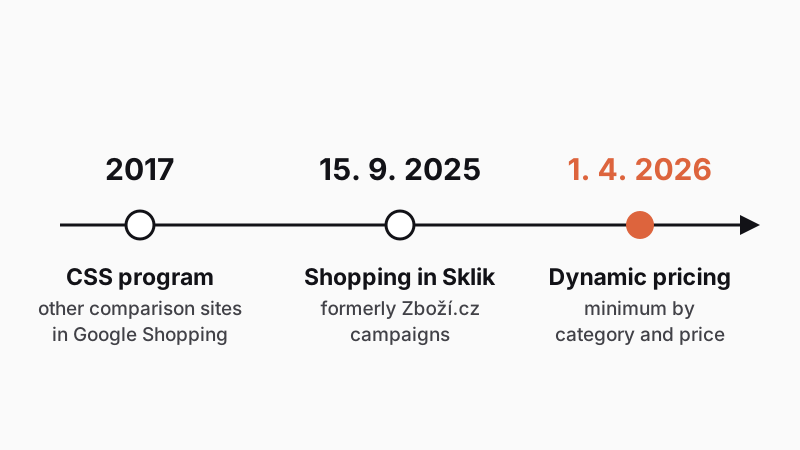
Since September 15, 2025, you manage Seznam Nákupy (formerly Zboží.cz campaigns) inside Sklik alongside text ads. According to the agency Conviu, campaigns were renamed "Nákupy" without needing to create new ones. Ads appear on Zboží.cz, Seznam.cz search, Obrázky.cz, and—for used or open-box items—on Sbazar. Seller Center (Centrum prodejce, the former Zboží.cz admin) handles feed management, diagnostics, shipping, and reviews.
Since April 1, 2026, dynamic pricing applies with no free listings. Per Sklik's help center, the minimum CPC depends on the category and price bracket and shifts with demand. The auction charges the minimum needed to hold your position, never below the listed floor price. Download the price list for your categories and check your feed and shipping in Seller Center.
Zboží.cz product pages use two sorting modes. "Recommended offers" rely on max CPC and relevance, though paid slots appear only when at least three stores sell the item. "Offers by price" weigh price, stock, and other factors—with a good price and items in stock, you can succeed without a high bid.
Google Shopping displays product ads with an image, price, and store name above search results. You pay per click in the Google Ads auction. You upload your product feed via Google Merchant Center, and free listings can also appear on the Shopping tab.
Today, paid ads typically run in Performance Max campaigns. Using one feed and budget, they advertise across Search, YouTube, Gmail, and the Display Network. Because the campaign decides where to spend your budget, track how many orders come from products versus searches for your own brand that would have arrived anyway.
Since 2017, other comparison sites in the European Economic Area and Switzerland can place shopping ads on Google under the CSS (Comparison Shopping Services) program. According to the Czech platform Upgates, this stemmed from a European Commission ruling. CSS partners report lower CPCs—in October 2024, Upgates wrote about savings of up to 20%. That is a partner claim rather than a Google guarantee, and results vary by partner, category, and competition. With a larger budget, test a CSS partner on part of your catalog and compare the cost per order. We compare Google and Seznam's ad network in Google Ads or Sklik.
Watch your tracking: Heureka, Sklik, and Google each attribute orders using their own tracking pixel. If a buyer touches multiple channels, each platform claims the sale, making reported totals exceed actual orders. Rely on your own store backend and analytics. We cover the setup basics in how to run a successful PPC campaign.
A marketplace brings many sellers together under one brand, helping you reach new buyers quickly without your own marketing. Active platforms in Czechia include Allegro.cz, Kaufland.cz, Alza's marketplace, and Heureka Marketplace. Allegro Group notes that with Allegro.cz, Allegro.sk, and Allegro.hu live, you can list items once and sell across multiple countries.
Selling on marketplaces makes sense in three cases:
Marketplaces can erode both margins and brand equity, though. The Seyfor survey notes they rely on price comparison, add little value, and restrict customer communication. When ten sellers list the exact same item, the lowest price wins.
Before joining a marketplace, decide which products to list, set floor prices, and plan how to measure profit after commissions, returns, and shipping. Keep your own brand and bestsellers exclusively on your store.
Marketplaces also monitor dispatch speed, cancellation rates, and response times. Missing their targets can restrict your account. Read the terms upfront and verify your warehouse can handle the Christmas peak.
Price comparison sites and marketplaces work well for easily comparable goods (electronics, cosmetics, tires) where your price and shipping are competitive. For private labels or unique catalogs, search ads, content, and customer retention usually deliver better returns.
| Channel | Pricing model | Customer belongs to | Best for |
|---|---|---|---|
| Heureka (PPC) | per click | you | comparable goods, competitive price |
| Heureka Marketplace | sales commission | mainly Heureka | fast launch, smaller stores |
| Seznam Nákupy | per click, dynamic pricing | you | reaching Czech shoppers |
| Google Shopping | auction per click | you | most online stores, export |
| Allegro, Kaufland | sales commission | mainly the marketplace | clearance, testing, export |
Calculate profitability per channel. Advertising cost of sales (ACOS / PNO) alone falls short because it ignores your margin. Focus on contribution margin: what remains after product cost, shipping, commissions or clicks, payment fees, and returns.
Take a sample item priced at CZK 1,000 excluding VAT with a 30% margin (CZK 300). On a marketplace charging a 12% commission on the VAT-inclusive price, you pay roughly CZK 145, leaving about CZK 155 before shipping and returns. On a comparison site at CZK 5 per click and a 2% conversion rate, an order costs CZK 250, leaving CZK 50. The marketplace wins on the first order, while the comparison site can catch up through direct repeat purchases. Track repeat orders too.
Roll out a new channel step by step:
A product feed is a file (usually XML) that supplies your product data to comparison sites and Google. Errors prevent products from matching, show wrong stock levels, or block listings entirely.
Five elements matter most:
We build online stores integrated with comparison sites, inventory, and accounting, and evaluate channel ROI as part of our marketing campaigns. If you are unsure which channel fits your store, get in touch.
For most stores selling comparable products, yes—provided your prices and reviews are competitive. Private-label brands usually see smaller gains. Profitability comes down to contribution margin after product cost, commissions, and clicks, not click volume.
They are Czech price comparison sites owned by different companies. Since September 2025, Zboží.cz is managed inside Sklik as Seznam Nákupy. Heureka runs its own admin panel, PPC listings, a commission-based Marketplace, and the Ověřeno zákazníky review program.
In the EEA and Switzerland, the CSS program lets third-party comparison sites place shopping ads on Google. It launched in 2017 following a European Commission decision. Partners report lower CPCs, though you should verify actual savings with a split test.
Allegro works well for clearing stock, testing new items, and exporting to Slovakia, Hungary, or Poland. However, the shopper remains the marketplace's customer. Calculate what is left after commissions, shipping, and returns, and keep your best items for your own store.
Handpicked topics for you
Search campaigns let you acquire new customers automatically, effortlessly, and cost-effectively.
Before buying, customers search for prices, drawbacks, and comparisons. Here is how to answer them honestly on your website and pick topics that bring real inquiries.
Base your total spend on customer economics. For splitting brand and performance, IPA's 60:40 average is a useful guide. Track brand strength free in twenty minutes a month.
Heureka, Seznam Nákupy, Google Shopping, and Allegro charge differently and vary in who keeps the customer. See what fits your margin and catalog.
Price comparison sites in Czechia (Heureka, Seznam Nákupy) charge mainly per click to your online store. Selling on marketplaces (Allegro, Heureka Marketplace) relies on a commission from purchases made directly on their platform. What pays off depends on your margin, catalog, brand strength, and product feed quality.
Here is the landscape in Czechia as of November 2026, including changes at Seznam and Heureka, the Google Shopping CSS program, and how marketplaces affect your margin. At the end, you will find a comparison table and a feed checklist.
Czech online stores generated CZK 206 billion in 2025 (up 6% year-over-year) and account for about 15% of retail, according to APEK and Heureka.cz cited in January 2026 by Zboží&Prodej. Shoppers go straight to known stores, compare prices, shipping, and reviews on comparison sites (Heureka, Zboží.cz, Google Shopping), or buy from multiple sellers on a marketplace.
In a 2025 Seyfor and B-inside survey of over 430 Czech and Slovak e-shops (MediaGuru, August 2025), 54% use marketplaces and 14% plan to. Yet for 70% of them, marketplaces generate at most 10% of revenue, and satisfaction is very low (NPS −71).
Treat sales channels as a portfolio: they differ in order cost, return rates, and customer ownership. Keep only those that remain profitable after deducting all expenses—see our guide to customer acquisition cost for the math.
Heureka offers two models. With pay-per-click (PPC), you also pay for visits without a purchase, but the shopper buys on your site—giving you their contact for your newsletter and database.
On Heureka Marketplace, shoppers buy directly on Heureka. According to its help center, Heureka acts as intermediary and guarantor, while you handle everything from order confirmation to returns. Setup and account management are free and you pay only a sales commission, but the customer remains mainly with the platform. PPC is like an ad pointing to your shop; commission is like renting a shelf in someone else's department store.
The commission on the item price (including VAT, excluding shipping) depends on the category—for kitchen appliances, the commission price list as of November 2026 ranged from roughly 4% to 15%. Compare it against your margin beforehand.
When prices match, trust decides. The Ověřeno zákazníky (Verified by Customers) program sends automated surveys to real buyers across all channels and awards a blue or gold certificate. As of November 2026, the help center lists the Start tier as free (15 surveys per month), while paid Profi and Enterprise tiers have higher limits. You improve your rating through fast dispatch, accurate stock status, and fair returns handling.
Since September 15, 2025, you manage Seznam Nákupy (formerly Zboží.cz campaigns) inside Sklik alongside text ads. According to the agency Conviu, campaigns were renamed "Nákupy" without needing to create new ones. Ads appear on Zboží.cz, Seznam.cz search, Obrázky.cz, and—for used or open-box items—on Sbazar. Seller Center (Centrum prodejce, the former Zboží.cz admin) handles feed management, diagnostics, shipping, and reviews.
Since April 1, 2026, dynamic pricing applies with no free listings. Per Sklik's help center, the minimum CPC depends on the category and price bracket and shifts with demand. The auction charges the minimum needed to hold your position, never below the listed floor price. Download the price list for your categories and check your feed and shipping in Seller Center.
Zboží.cz product pages use two sorting modes. "Recommended offers" rely on max CPC and relevance, though paid slots appear only when at least three stores sell the item. "Offers by price" weigh price, stock, and other factors—with a good price and items in stock, you can succeed without a high bid.
Google Shopping displays product ads with an image, price, and store name above search results. You pay per click in the Google Ads auction. You upload your product feed via Google Merchant Center, and free listings can also appear on the Shopping tab.
Today, paid ads typically run in Performance Max campaigns. Using one feed and budget, they advertise across Search, YouTube, Gmail, and the Display Network. Because the campaign decides where to spend your budget, track how many orders come from products versus searches for your own brand that would have arrived anyway.
Since 2017, other comparison sites in the European Economic Area and Switzerland can place shopping ads on Google under the CSS (Comparison Shopping Services) program. According to the Czech platform Upgates, this stemmed from a European Commission ruling. CSS partners report lower CPCs—in October 2024, Upgates wrote about savings of up to 20%. That is a partner claim rather than a Google guarantee, and results vary by partner, category, and competition. With a larger budget, test a CSS partner on part of your catalog and compare the cost per order. We compare Google and Seznam's ad network in Google Ads or Sklik.
Watch your tracking: Heureka, Sklik, and Google each attribute orders using their own tracking pixel. If a buyer touches multiple channels, each platform claims the sale, making reported totals exceed actual orders. Rely on your own store backend and analytics. We cover the setup basics in how to run a successful PPC campaign.
A marketplace brings many sellers together under one brand, helping you reach new buyers quickly without your own marketing. Active platforms in Czechia include Allegro.cz, Kaufland.cz, Alza's marketplace, and Heureka Marketplace. Allegro Group notes that with Allegro.cz, Allegro.sk, and Allegro.hu live, you can list items once and sell across multiple countries.
Selling on marketplaces makes sense in three cases:
Marketplaces can erode both margins and brand equity, though. The Seyfor survey notes they rely on price comparison, add little value, and restrict customer communication. When ten sellers list the exact same item, the lowest price wins.
Before joining a marketplace, decide which products to list, set floor prices, and plan how to measure profit after commissions, returns, and shipping. Keep your own brand and bestsellers exclusively on your store.
Marketplaces also monitor dispatch speed, cancellation rates, and response times. Missing their targets can restrict your account. Read the terms upfront and verify your warehouse can handle the Christmas peak.
Price comparison sites and marketplaces work well for easily comparable goods (electronics, cosmetics, tires) where your price and shipping are competitive. For private labels or unique catalogs, search ads, content, and customer retention usually deliver better returns.
| Channel | Pricing model | Customer belongs to | Best for |
|---|---|---|---|
| Heureka (PPC) | per click | you | comparable goods, competitive price |
| Heureka Marketplace | sales commission | mainly Heureka | fast launch, smaller stores |
| Seznam Nákupy | per click, dynamic pricing | you | reaching Czech shoppers |
| Google Shopping | auction per click | you | most online stores, export |
| Allegro, Kaufland | sales commission | mainly the marketplace | clearance, testing, export |
Calculate profitability per channel. Advertising cost of sales (ACOS / PNO) alone falls short because it ignores your margin. Focus on contribution margin: what remains after product cost, shipping, commissions or clicks, payment fees, and returns.
Take a sample item priced at CZK 1,000 excluding VAT with a 30% margin (CZK 300). On a marketplace charging a 12% commission on the VAT-inclusive price, you pay roughly CZK 145, leaving about CZK 155 before shipping and returns. On a comparison site at CZK 5 per click and a 2% conversion rate, an order costs CZK 250, leaving CZK 50. The marketplace wins on the first order, while the comparison site can catch up through direct repeat purchases. Track repeat orders too.
Roll out a new channel step by step:
A product feed is a file (usually XML) that supplies your product data to comparison sites and Google. Errors prevent products from matching, show wrong stock levels, or block listings entirely.
Five elements matter most:
We build online stores integrated with comparison sites, inventory, and accounting, and evaluate channel ROI as part of our marketing campaigns. If you are unsure which channel fits your store, get in touch.
For most stores selling comparable products, yes—provided your prices and reviews are competitive. Private-label brands usually see smaller gains. Profitability comes down to contribution margin after product cost, commissions, and clicks, not click volume.
They are Czech price comparison sites owned by different companies. Since September 2025, Zboží.cz is managed inside Sklik as Seznam Nákupy. Heureka runs its own admin panel, PPC listings, a commission-based Marketplace, and the Ověřeno zákazníky review program.
In the EEA and Switzerland, the CSS program lets third-party comparison sites place shopping ads on Google. It launched in 2017 following a European Commission decision. Partners report lower CPCs, though you should verify actual savings with a split test.
Allegro works well for clearing stock, testing new items, and exporting to Slovakia, Hungary, or Poland. However, the shopper remains the marketplace's customer. Calculate what is left after commissions, shipping, and returns, and keep your best items for your own store.
Handpicked topics for you
Search campaigns let you acquire new customers automatically, effortlessly, and cost-effectively.
Before buying, customers search for prices, drawbacks, and comparisons. Here is how to answer them honestly on your website and pick topics that bring real inquiries.
Base your total spend on customer economics. For splitting brand and performance, IPA's 60:40 average is a useful guide. Track brand strength free in twenty minutes a month.